When income rises by Rs.10, then induced consumption will rise by?
Answer & explanation
Correct answer: option 2
The correct answer is Option (2) → Marginal propensity to consume (MPC).
Note: The given answer is as per the official NTA Answer Key. However, the question can have more than one correct answer, i.e. both Option (2) and Option (3), as explained below.
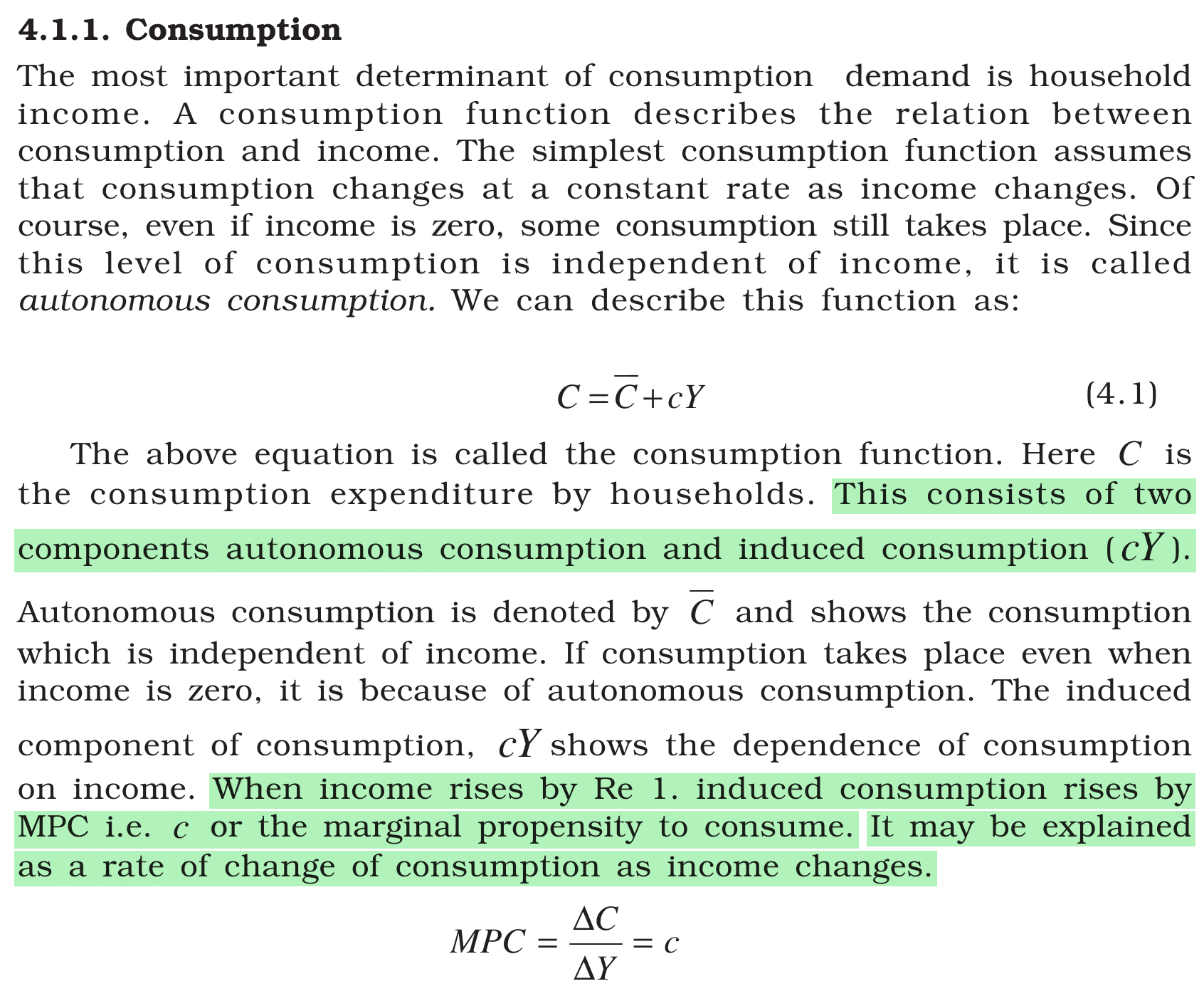
Part of what people consume does not depend on income — this is autonomous consumption — and the rest, induced consumption cY, rises as income rises. How much it rises for each rupee of extra income is the marginal propensity to consume:
MPC = ΔC/ΔY
So ΔC = MPC × ΔY
Induced consumption therefore rises at the rate of MPC for every rupee of extra income, and by MPC × ΔY in all. For a rise in income of Rs.10:
Rise in induced consumption = MPC × Rs.10
With an MPC of 0.8, for instance, the rise is 0.8 × 10 = Rs.8
Taking the options one by one:
Option (1) Average propensity to consume (APC). — Incorrect. APC = C/Y is consumption per unit of income at a given level of income. It describes a level, not a change, so it cannot measure how much consumption rises when income rises.
Option (2) Marginal propensity to consume (MPC). — Correct. MPC is the rate at which induced consumption rises with income: every rupee of extra income raises consumption by MPC.
Option (3) MPC times rise in income. — Correct. Since ΔC = MPC × ΔY, the actual amount by which induced consumption rises is MPC times the rise in income, ten times the MPC for a rise of Rs.10.
Option (4) Marginal propensity to save (MPS). — Incorrect. MPS = 1 − MPC is the share of extra income that is saved. It measures the rise in saving, not in consumption.
NCERT: Introductory Macroeconomics — Chapter 4: Determination of Income and Employment (2025-26)
|