Which compound is the most basic in nature among the following ?
Answer & explanation
Correct answer: option 1
The correct answer is Option (1) → p-Methylaniline
Aniline is a weaker base than aliphatic amines because the lone pair on nitrogen is delocalised into the benzene ring by resonance and is less available to accept a proton. A substituent on the ring changes this further:
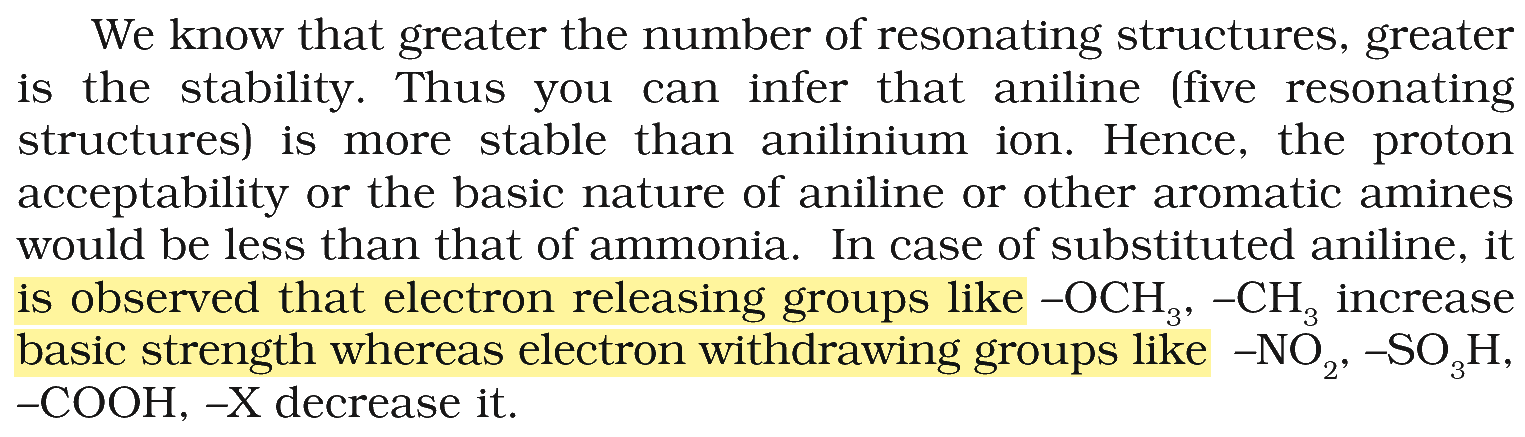
Electron releasing groups (–\( \ce{CH3} \), –\( \ce{OCH3} \)) push electron density towards –\( \ce{NH2} \) and increase basicity.
Electron withdrawing groups (–\( \ce{NO2} \), –CN, halogens) pull electron density away and decrease basicity.
\( \ce{-CH3} \) releases electrons by the +I effect and by hyperconjugation. At the para position both effects reach the carbon bearing –\( \ce{NH2} \); at the meta position only the weak +I effect works. So p-methylaniline is the strongest base here:
p-methylaniline > m-methylaniline > aniline > o-nitroaniline
So the most basic compound is p-methylaniline.
Why the other options are incorrect
Option (2) m-Methylaniline — Incorrect. From the meta position –\( \ce{CH3} \) helps only by a weak +I effect, so it is less basic than the para isomer.
Option (3) Aniline — Incorrect. It has no electron releasing group, so it is weaker than both methylanilines.
Option (4) o-Nitroaniline — Incorrect. –\( \ce{NO2} \) is a strong electron withdrawing group (–I, –R), and at the ortho position it also forms an intramolecular hydrogen bond with –\( \ce{NH2} \). It is a very weak base.
NCERT (2026-27 edition):
Chemical Reactions – …