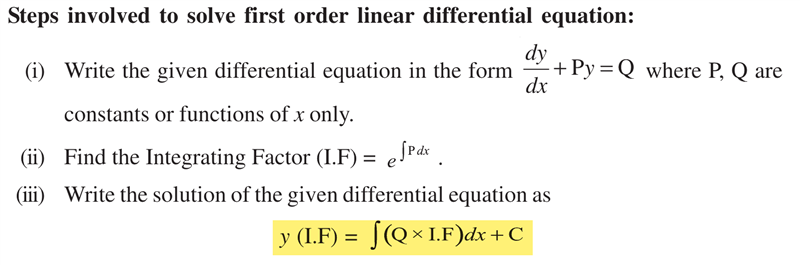
The general solution of the differential equation of the type \( \displaystyle\frac{dy}{dx}+py=Q \) is:
(where \( P \) and \( Q \) are functions of \( x \) only or constant)
Answer & explanation
Correct answer: option 2
The correct answer is Option (2) → \( y\ e^{\int p\,dx}=\int\left(Q\ e^{\int p\,dx}\right)dx+c \) : (where \( c \) is an arbitrary constant)
The equation is linear in y, with p and Q functions of x (the bracket writes the same coefficient as P).
Its integrating factor is
\( \displaystyle \text{I.F.}=e^{\int p\,dx} \)
Multiplying the equation by the I.F. makes the left side an exact derivative:
\( \displaystyle e^{\int p\,dx}\frac{dy}{dx}+p\,e^{\int p\,dx}\,y=\frac{d}{dx}\left(y\,e^{\int p\,dx}\right) \)
\( \displaystyle \frac{d}{dx}\left(y\,e^{\int p\,dx}\right)=Q\,e^{\int p\,dx} \)
Integrating with respect to x:
\( \displaystyle y\,e^{\int p\,dx}=\int\left(Q\,e^{\int p\,dx}\right)dx+c \)
Why the other options are incorrect
Option (1) \( y\ e^{\int p\,dy}=\int\left(Q\ e^{\int p\,dy}\right)dy+c \): (where \( c \) is an arbitrary constant) — Incorrect. Since p and Q are functions of x, the integrating factor and the integration are with respect to x, not y.
Option (3) \( x\ e^{\int p\,dy}=\int\left(Q\ e^{\int p\,dy}\right)dy+c \) : (where \( c \) is an arbitrary constant) — Incorrect. This is the form for \( \frac{dx}{dy}+px=Q \), where p and Q are functions of y; here the dependent variable is y.
Option (4) \( x\ e^{\int p\,dy}=\int\left(Q\ e^{\int p\,dx}\right)dx+c \) (where \( c \) is an arbitrary constant) — Incorrect. This mixes the two forms: the unknown is y, not x, and the integrating factor must be \( e^{\int p\,dx} \) on both sides.
NCERT (2026-27 edition):
Linear Differential Equations