Read the passage carefully and answer the Questions.
Aldehydes and ketones are important organic compounds prepared mainly by oxidation of alcohols. Primary alcohols give aldehyde and secondary alcohols yield ketones. Aldehydes can also be formed by partial reduction of acid chlorides, reduction of esters or by Gattermann-Koch reaction. Ketones are prepared via Friedel-Craft's acylation, hydration of alkyne and reaction of Grignard's reagent with nitriles. Chemically, aldehydes and ketones are reactive in nature due to the carbonyl group and undergo nucleophilic addition reactions. Aldehydes are more reactive than ketones and can be oxidized to carboxylic acids, while both can be reduced to alcohols or hydrocarbons and exhibit condensation reaction.
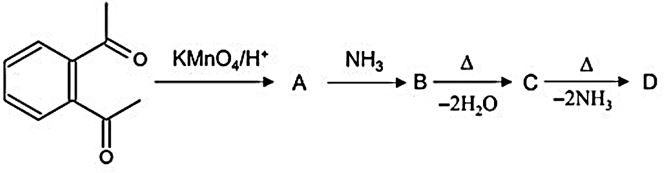
Predict the end product (D) of the following reaction sequence;
Answer & explanation
Correct answer: option 3
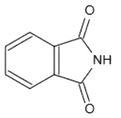
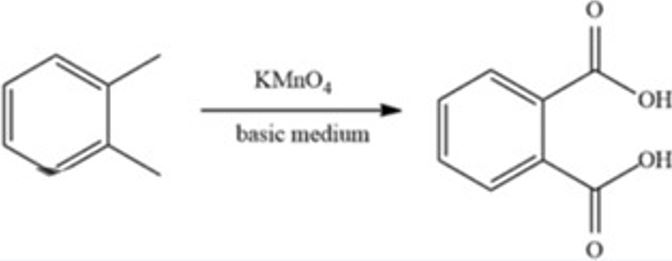
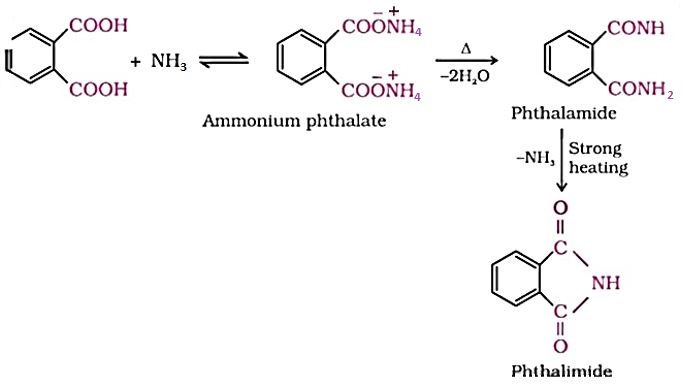
The correct answer is Option (3) Step 1: Oxidation with $KMnO_4$ Hot acidic $KMnO_4$ oxidizes any alkyl side chain attached to a benzene ring to carboxylic acid ($-COOH$). Thus the starting compound with two adjacent side chains becomes: Phthalic acid (benzene-1,2-dicarboxylic acid) This is compound A. Step 2: Reaction with $NH_3$ Phthalic acid reacts with ammonia to form phthalic acid diamide (ammonium intermediate). This produces phthalamide type intermediate B. Step 3: Dehydration ($-2H_2O$) Heating causes dehydration forming a cyclic intermediate. Step 4: Loss of $NH_3$ Further cyclization and elimination of ammonia forms the cyclic imide: Phthalimide Structure: A benzene ring fused with an imide group ($-CO-NH-CO-$).