The Germanium (Ge) is doped by Antimony atoms. Which one of the following is CORRECT?
Answer & explanation
Correct answer: option 4
The correct answer is Option (4) → Donor level is created near conduction band.
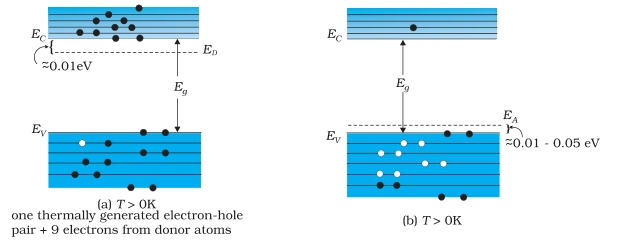
Antimony (Sb) is a pentavalent element (group 15). Four of its five valence electrons form covalent bonds with neighbouring germanium atoms; the fifth is loosely bound and needs only about 0.01 eV to become free. Sb is therefore a donor impurity and makes an n-type semiconductor.
The energy of this loosely bound electron lies in the band gap just below the bottom of the conduction band, so a donor level is created near the conduction band.
Why the other options are incorrect
Option (1) Acceptor level is created near the conduction band. — Incorrect. Acceptor levels are created by trivalent impurities (B, Al, Ga, In), and they lie near the valence band, not the conduction band.
Option (2) Donor level is created near valence band. — Incorrect. A donor level lies near the conduction band, because its electron needs only a very small energy to enter that band.
Option (3) Acceptor level is created near valence band. — Incorrect. This is what a trivalent impurity such as indium would do, making a p-type semiconductor; antimony is pentavalent.
NCERT (2026-27):
Extrinsic Semiconductor – “… In the case of extrinsic semiconductors, additional energy states due to donor impurities (\( E_D \)) and acceptor impurities (\( E_A \)) also exist. In the energy band diagram of n-type Si semiconductor, the donor energy level \( E_D \) is slightly below the bottom \( E_C \) of the conduction band and electrons from this level move into the conduction band with very small supply of energy. … Similarly, for p-type semiconductor, the acceptor energy level \( E_A \) is slightly above the top \( E_V \) of the valence band as shown in Fig. 14.9(b).”