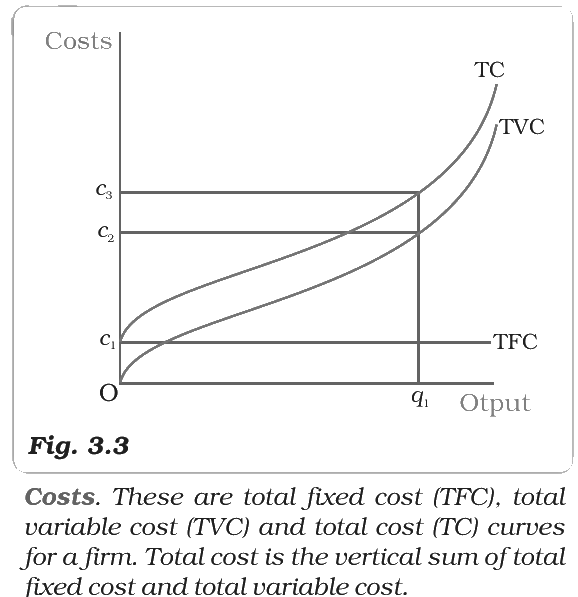
Consider the following statements about the TFC, TVC and TC curves of a firm in the short run:
(A) The TC curve starts from the level of TFC on the cost axis.
(B) The TVC curve starts from the origin.
(C) At every level of output, the vertical gap between the TC and TVC curves equals TFC.
(D) The TC and TVC curves come closer to each other as output rises.
Choose the correct answer from the options given below:
Answer & explanation
Correct answer: option 4
The correct answer is Option (4) → (A), (B) and (C) only
TC = TVC + TFC, and TFC stays the same at every output.
(A) The TC curve starts from the level of TFC on the cost axis. — Correct. At zero output TVC is zero, so TC is just the fixed cost.
(B) The TVC curve starts from the origin. — Correct. With no output, no variable input is used, so TVC is zero.
(C) At every level of output, the vertical gap between the TC and TVC curves equals TFC. — Correct. TC − TVC = TFC at every output.
(D) The TC and TVC curves come closer to each other as output rises. — Incorrect. The gap between TC and TVC is TFC, which is constant. So the two curves stay the same distance apart; they never come closer.
NCERT (2026-27): “3.7.1 Short Run Costs … In Table 3.3, we have an example of cost function of a typical firm. The first column shows different levels of output. For all levels of output, the total fixed cost is Rs 20. Total variable cost increases as output increases. With output zero, TVC is zero. For 1 unit of output, TVC is Rs 10; for 2 units of output, TVC is Rs 18 and so on. In the fourth column, we obtain the total cost (TC) as the sum of the corresponding values in second column (TFC) and third column (TVC). At zero level of output, TC is just the fixed cost, and hence, equal to Rs 20. For 1 unit of output, total cost is Rs 30; for 2 units of output, the TC is Rs 38 and so on.” “Shapes of the Short Run Cost Curves … Previously, we have discussed that in order to increase the production of output the firm needs to employ more of the variable inputs. This results in an increase in total variable cost, and hence, an increase in total cost. Therefore, as output increases, total variable cost and total cost increase. Total fixed cost, however, is independent of the amount of output produced and remains constant for all levels of production.”
|