
Chemical Kinetics
Kinetic studies not only help us to determine the speed or rate of a chemical reaction but also describe the conditions under which the reaction rates can be altered. Some reactions such as ionic reactions are very fast while some others like rusting of iron are very slow. Also, there are reactions like inversion of cane sugar and hydrolysis of starch, which proceed at a moderate speed. The rate of a reaction can be defined as the change in concentration of a reactant or product per unit time. The unit used to express the rate of a reaction is concentration time−1. The rate of a reaction can be determined in terms of the average rate of reaction or can be determined at a particular instant of time called the instantaneous rate of reaction. The rate of a chemical reaction at a given temperature depends on the concentration of one or more reactants. The representation of the rate of reaction in terms of concentration of the reactants is known as rate law. Rate law for any reaction cannot be predicted by merely looking at the balanced chemical equation, i.e., theoretically, but must be determined experimentally.
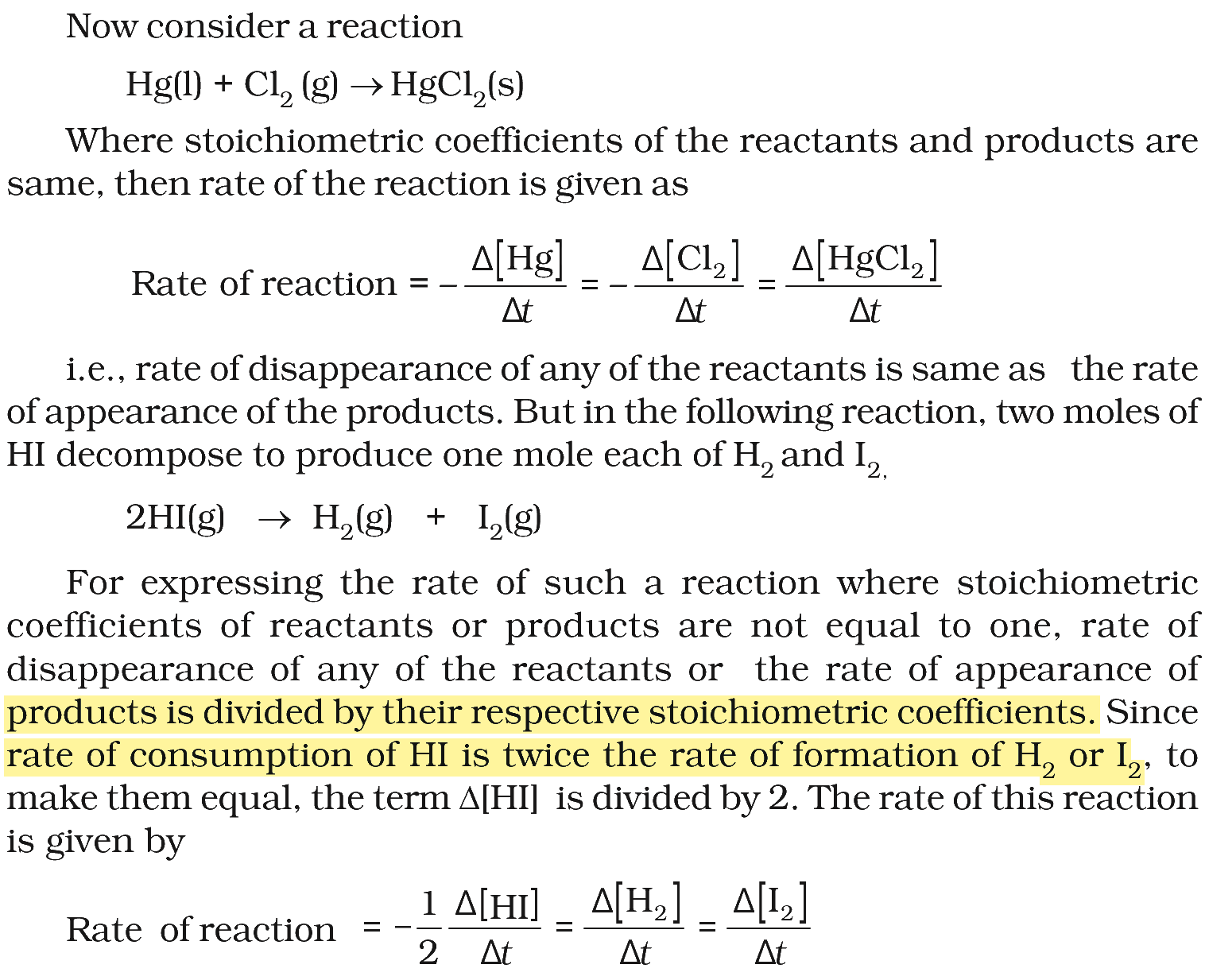
Which of the following correctly represents the rate of the given reaction?
2HI (g) → H2 (g) + I2 (g)
Answer & explanation
Correct answer: option 2
The correct answer is Option (2) → \( \displaystyle -\frac{1}{2}\frac{\Delta[HI]}{\Delta t}=\frac{\Delta[H_2]}{\Delta t}=\frac{\Delta[I_2]}{\Delta t} \)
When the coefficients in a balanced equation are not all equal, the reactants and products change concentration at different speeds. To get one rate for the whole reaction, each rate of change is divided by the coefficient of that species, and reactants take a minus sign (their concentration falls). For a general reaction:
\( \displaystyle a\mathrm{A}+b\mathrm{B}\rightarrow c\mathrm{C}+d\mathrm{D} \)
\( \displaystyle \text{Rate}=-\frac{1}{a}\frac{\Delta[\mathrm{A}]}{\Delta t}=-\frac{1}{b}\frac{\Delta[\mathrm{B}]}{\Delta t}=+\frac{1}{c}\frac{\Delta[\mathrm{C}]}{\Delta t}=+\frac{1}{d}\frac{\Delta[\mathrm{D}]}{\Delta t} \)
For 2HI(g) → H2(g) + I2(g), the coefficients are 2 for HI and 1 each for \( \ce{H2} \) and \( \ce{I2} \):
\( \displaystyle \text{Rate}=-\frac{1}{2}\frac{\Delta[HI]}{\Delta t}=\frac{\Delta[H_2]}{\Delta t}=\frac{\Delta[I_2]}{\Delta t} \)
This says that HI is used up twice as fast as \( \ce{H2} \) or \( \ce{I2} \) is formed, which is what the equation shows. So the correct expression is Option (2).
Why the other options are incorrect
Option (1) \( \displaystyle -\frac{1}{2}\frac{\Delta[HI]}{\Delta t}=-\frac{1}{2}\frac{\Delta[H_2]}{\Delta t}=\frac{\Delta[I_2]}{\Delta t} \) — Incorrect. \( \ce{H2} \) is a product with coefficient 1, so its term takes a plus sign and no factor 1/2; as written it would make the rate negative.
Option (3) \( \displaystyle \frac{\Delta[HI]}{\Delta t}=\frac{2\Delta[H_2]}{\Delta t}=\frac{\Delta[I_2]}{\Delta t} \) — Incorrect. It has no minus sign for the reactant, and \( \ce{H2} \) and \( \ce{I2} \), which form in equal amounts, carry different factors.
Option (4) \( \displaystyle \frac{1}{2}\frac{\Delta[HI]}{\Delta t}=\frac{\Delta[H_2]}{\Delta t}=\frac{\Delta[I_2]}{\Delta t} \) — Incorrect. The minus sign for the reactant is missing. [HI] falls, so this term is negative while the product terms are positive.
NCERT (2026-27 edition):
Rate of a Chemical Reaction – …
Note: The same/similar question has been asked in different years by NTA as per the details given below:
| 2026 | 2025 | 2024 | 2023 | 2022 |
|---|---|---|---|---|
| 26-05 S1 24-05 S2 | – | – | – | – |