The value of a determinant is unaltered if :
Answer & explanation
Correct answer: option 4
The correct answer is Option (4) → to each element of a row (or a column) are added equimultiples of the corresponding elements of another row (or column)
By a property of determinants, the operation \(R_i \to R_i + kR_j\) (or \(C_i \to C_i + kC_j\)) does not change the value of the determinant.
The reason: after the operation, the determinant splits into the original determinant plus k times a determinant with two identical rows, and a determinant with two identical rows is 0.
Why the other options are incorrect
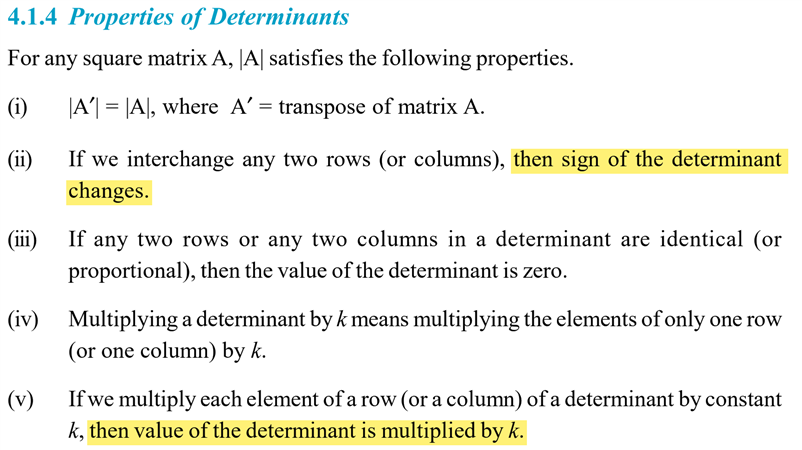
Option (1) two rows are interchanged — Incorrect. Interchanging two rows changes the sign of the determinant.
Option (2) two columns are interchanged — Incorrect. Interchanging two columns also changes the sign.
Option (3) every element of a row (or column) is multiplied by the same number — Incorrect. Multiplying a row by k multiplies the determinant by k.
NCERT Exemplar:
Determinants