Festinger and Carlsmith conducted a famous experiment in the field of social psychology. This experiment was related to:
Answer & explanation
Correct answer: option 3
The correct answer is Option (3) → Cognitive dissonance
Option (1) Groupthink — Incorrect. Groupthink, studied by Irving Janis, is the appearance of consensus in a highly cohesive group whose concern for unanimity leads to uncritical decisions. Festinger and Carlsmith studied single students and their attitudes, not group decisions.
Option (2) Prejudice — Incorrect. Prejudice is a negative attitude towards a particular group, often based on a stereotype about that group. The experiment did not deal with attitudes towards any group of people.
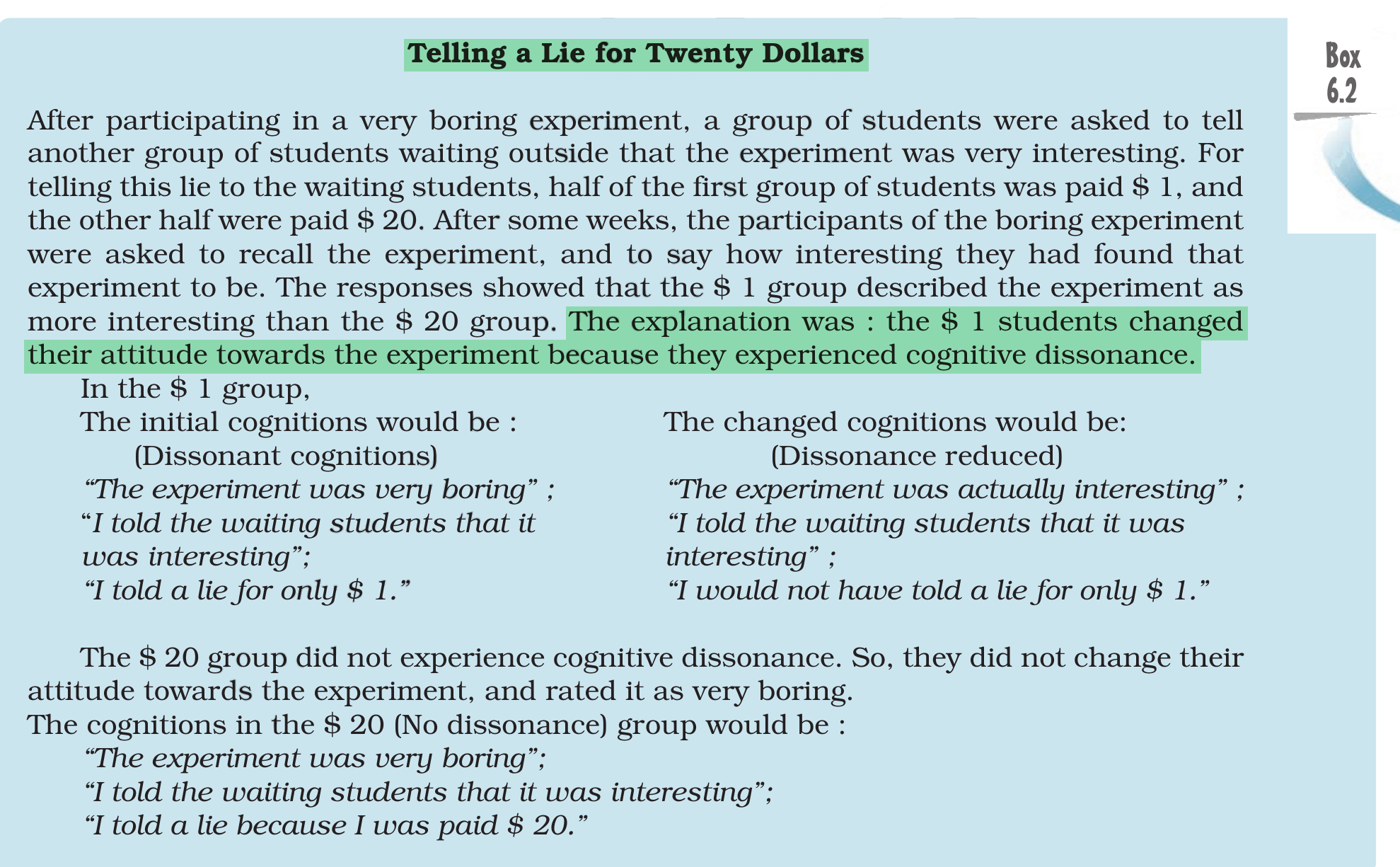
Option (3) Cognitive dissonance — Correct. Festinger and Carlsmith’s experiment showed how cognitive dissonance works. Students who had done a very boring task were paid $1 or $20 to tell waiting students that it was interesting. Weeks later the $1 group described the task as more interesting: ‘I told a lie for only $1’ clashed with ‘it was boring’, so they changed their attitude to remove the dissonance. The $20 group had a good reason for the lie, felt no dissonance and still called it boring.
Option (4) Schema — Incorrect. A schema is a system of beliefs and action patterns built up from experience, as in Beck’s core schemas formed in childhood. The experiment was about a change in attitude after saying something one did not believe, not about such a framework.
NCERT (2025-26): “Process of Attitude Change … (b) The concept of cognitive dissonance was proposed by Leon Festinger. It emphasises the cognitive component. Here the basic idea is that the cognitive components of an attitude must be ‘consonant’ (opposite of ‘dissonant’), i.e., they should be logically in line with each other. If an individual finds that two cognitions in an attitude are dissonant, then one of them will be changed in the direction of consonance.…” “…Festinger and Carlsmith, two social psychologists, conducted an experiment that showed how cognitive dissonance works (see Box 6.2).…”
|