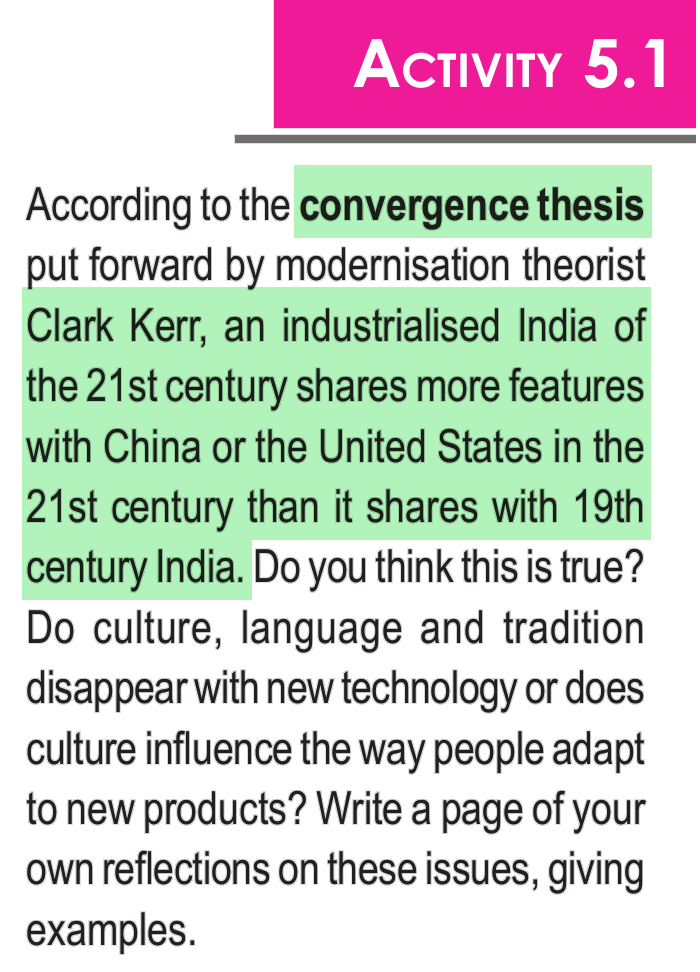
In his 'convergence thesis' Clark Kerr said that an industrialised India of the 21st century shares more features with China or USA of the 21st century than with 19th century India. What did he mean by this?
Answer & explanation
Correct answer: option 3
The correct answer is Option (3) → Rising similarity of culture across countries due to modernisation and industrialisation.
Option (1) Stronger trade relations across countries in 21st century than in 19th century. — Incorrect. The thesis compares what societies are like, not how much they trade. India could trade more and still be unlike China or the USA.
Option (2) Social and economic equality across countries in 21st century. — Incorrect. Becoming alike is not the same as becoming equal. The thesis says nothing about countries reaching the same level of wealth or removing inequality.
Option (3) Rising similarity of culture across countries due to modernisation and industrialisation. — Correct. Clark Kerr was a modernisation theorist. His convergence thesis says that industrialisation makes societies converge, that is, grow alike: an industrialised India of the 21st century has more in common with China or the USA of today than with its own 19th-century past. The question it raises is whether culture, language and tradition give way before new technology.
Option (4) Use of modern methods of production across countries. — Incorrect. Modern methods of production are the cause in the thesis, not its claim. Kerr’s point is that, because of industrialisation, the societies themselves come to resemble one another.
NCERT: Social Change and Development in India — Chapter 5: Change and Development in Industrial Society (2025-26)
|