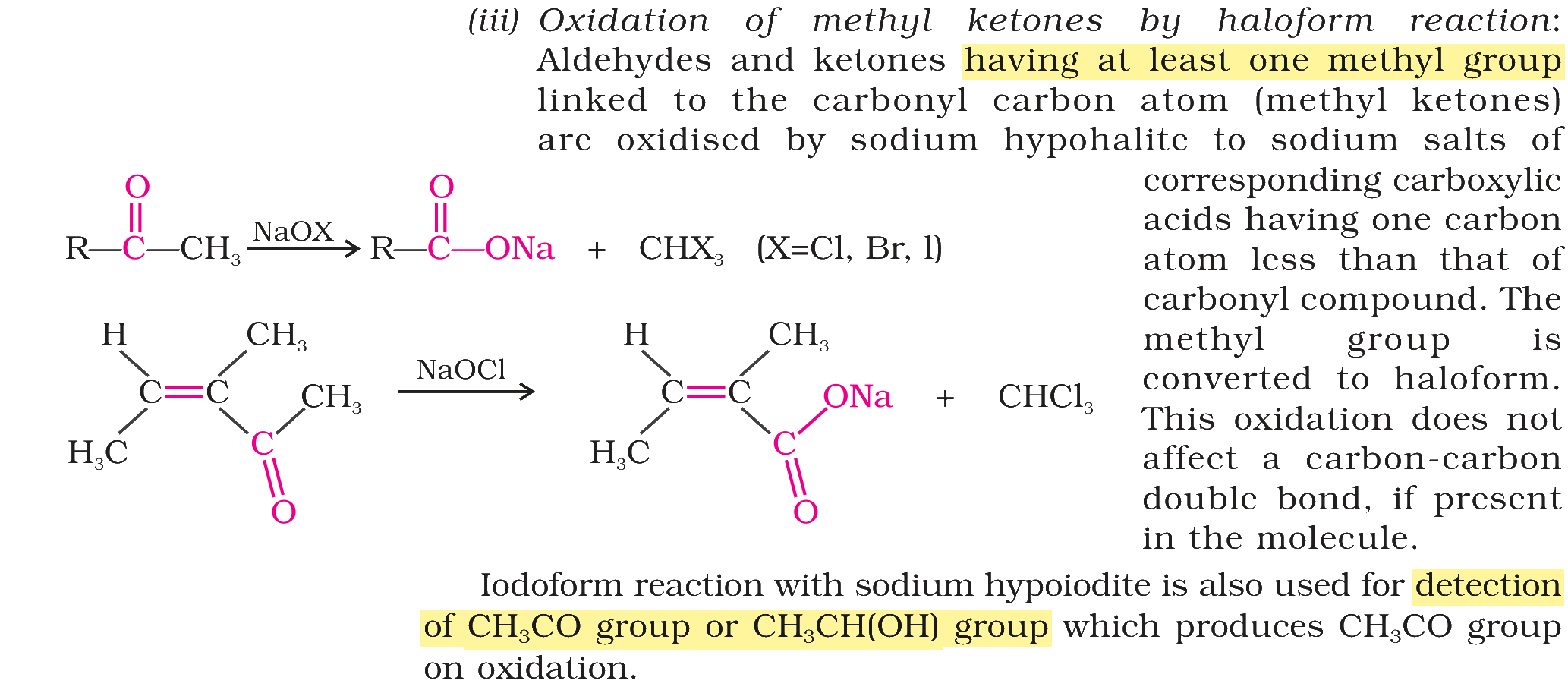
Haloform test is given by
(A) Formaldehyde
(B) Acetone
(C) \( α \)-Phenyl ethyl alcohol
(D) Acetaldehyde
Choose the correct answer from the options given below:
Answer & explanation
Correct answer: option 4
The correct answer is Option (4) → (B), (C) and (D) only
(A) Formaldehyde — Incorrect. HCHO has no methyl group on the carbonyl carbon, so it does not give the haloform test.
(B) Acetone — Correct. \( \ce{CH3COCH3} \) is a methyl ketone:
\( \displaystyle \ce{CH3COCH3 + 3NaOI -> CH3COONa + CHI3 v + 2NaOH} \)
(C) \(α\)-Phenyl ethyl alcohol — Correct. This is \( \ce{C6H5CH(OH)CH3} \), which has the \( \ce{CH3CH(OH)} \)– group. It is first oxidised to acetophenone, \( \ce{C6H5COCH3} \), which then gives iodoform and sodium benzoate.
(D) Acetaldehyde — Correct. \( \ce{CH3CHO} \) is the only aldehyde with a \( \ce{CH3CO} \)– group:
\( \displaystyle \ce{CH3CHO + 3NaOI -> HCOONa + CHI3 v + 2NaOH} \)
Shortcut: Formaldehyde has no methyl group, so any option containing (A) is out; only Option (4) remains.
NCERT (2026-27 edition):
Oxidation of Methyl Ketones by Haloform Reaction