Answer & explanation
Correct answer: option 4
The correct answer is Option (4) → India considered it discriminatory
Option (1) India wanted to become a Nuclear power as it wanted to influence Asian countries — Incorrect.
Option (2) India wanted to use Nuclear weapons for defense purposes only — Incorrect. India said that it was committed to the policy of using nuclear power only for peaceful purposes; this was its stated nuclear policy.
Option (3) India did not want to give up its Nuclear weapons as it planned to become a superpower — Incorrect.
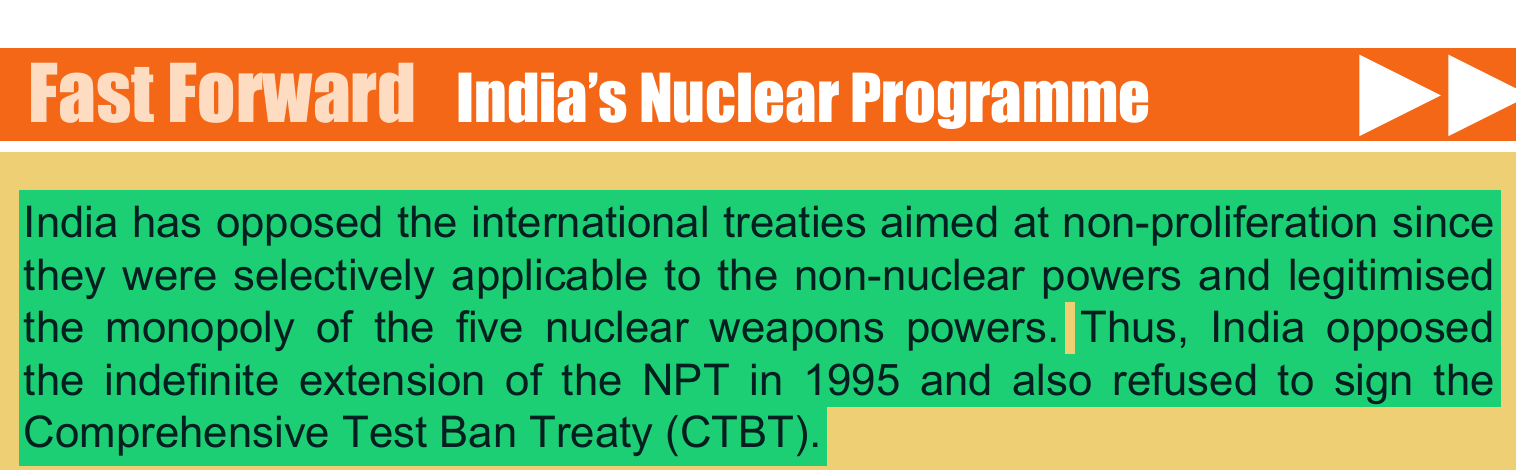
Option (4) India considered it discriminatory — Correct. India always considered the NPT discriminatory. The non-proliferation treaties were selectively applicable to the non-nuclear powers and legitimised the monopoly of the five nuclear weapons powers, so India opposed the indefinite extension of the NPT in 1995 and refused to sign the CTBT.
NCERT (2026-27): “India’s nuclear policy Another crucial development of this period was the first nuclear explosion undertaken by India in May 1974. Nehru had always put his faith in science and technology for rapidly building a modern India. A significant component of his industrialisation plans was the nuclear programme initiated in the late 1940s under the guidance of Homi J. Bhabha. India wanted to generate atomic energy for peaceful purposes. Nehru was against nuclear weapons. So he pleaded with the superpowers for comprehensive nuclear disarmament. However, the nuclear arsenal kept rising. When Communist China conducted nuclear tests in October 1964, the five nuclear weapon powers, the US, USSR, UK, France, and China (Taiwan then represented China) – also the five Permanent Members of the UN Security Council – tried to impose the Nuclear Non-proliferation Treaty (NPT) of 1968 on the rest of the world. India always considered the NPT as discriminatory and had refused to sign it. When India conducted its first nuclear test, it was termed as peaceful explosion. India argued that it was committed to the policy of using nuclear power only for peaceful purposes.…”
|