
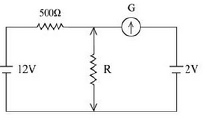
The galvanometer G in the circuit reads zero (no deflection). If the batteries are resistance less, the value of R would be:
Answer & explanation
Correct answer: option 4
The correct answer is Option (4) → \( 100\,\Omega \)
When the galvanometer shows no deflection, no current flows in the branch with the 2 V battery, so that battery is exactly balanced by the potential difference across R. The 12 V battery, the \( 500\,\Omega \) resistor and R then form a single series loop (a potential divider), and the voltage across R must be 2 V.
\( \displaystyle I = \frac{12\,\mathrm{V}}{500\,\Omega+R} \)
\( \displaystyle V_R = IR = \frac{12R}{500+R} = 2 \)
\( 12R = 1000+2R \Rightarrow 10R = 1000 \)
\( R = 100\,\Omega \)
Check: \( I = 12/600 = 0.02\,\mathrm{A} \), the drop across \( 500\,\Omega \) is 10 V and across R is \( 0.02\times100 = 2\,\mathrm{V} \), which balances the 2 V battery.