Read the passage carefully and answer the Questions.
Aldehydes and ketones are important organic compounds prepared mainly by oxidation of alcohols. Primary alcohols give aldehyde and secondary alcohols yield ketones. Aldehydes can also be formed by partial reduction of acid chlorides, reduction of esters or by Gattermann-Koch reaction. Ketones are prepared via Friedel-Craft's acylation, hydration of alkyne and reaction of Grignard's reagent with nitriles. Chemically, aldehydes and ketones are reactive in nature due to the carbonyl group and undergo nucleophilic addition reactions. Aldehydes are more reactive than ketones and can be oxidized to carboxylic acids, while both can be reduced to alcohols or hydrocarbons and exhibit condensation reaction.
Hydration of propyne in the presence of $H_2SO_4$ and $HgSO_4$ gives
Answer & explanation
Correct answer: option 2
The correct answer is Option (2) → Propan-2-one
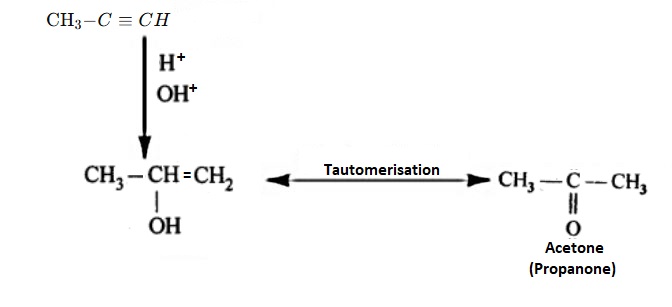
Hydration of propyne (CH₃–C≡CH) in the presence of H₂SO₄ and HgSO₄ follows Markovnikov addition to give an enol, which rapidly tautomerizes to a ketone.
Reaction sequence:
- Propyne → enol → ketone
Final product formed is propan-2-one (acetone).