Match List-I with List-II
|
List-I Name Reaction |
List-II Reaction |
|
(A) Stephen Reaction |
(I) |
|
(B) Gatterman-Koch Reaction |
(II) |
|
(C) Etard Reaction |
(III) |
|
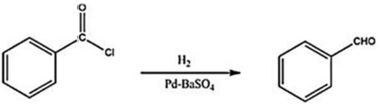
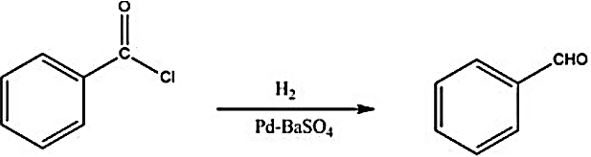
(D) Rosenmund reduction |
(IV) |



Choose the correct answer from the options given below:
Answer & explanation
Correct answer: option 1
The correct answer is Option (1) → (A)-(II), (B)-(I), (C)-(IV), (D)-(III)
|
List-I Name Reaction |
List-II Reaction |
|
(A) Stephen Reaction |
(II) |
|
(B) Gatterman-Koch Reaction |
(I) |
|
(C) Etard Reaction |
(IV) |
|
(D) Rosenmund reduction |
(III) |
Each named reaction converts different functional groups into aldehydes.
Stephen Reaction
In the Stephen reaction, nitriles (RCN) are reduced using SnCl₂ and HCl to form an iminium salt, which on hydrolysis produces an aldehyde.
Reaction:
RCN → SnCl₂+ HCl → RCH=NH → (H₃O⁺) → RCHO
Thus, Stephen reaction corresponds to reaction (II).
Gatterman-Koch Reaction
This reaction introduces a formyl group (–CHO) into an aromatic ring.
Benzene reacts with CO and HCl in the presence of AlCl₃ and CuCl catalyst to produce benzaldehyde.
Thus, Gatterman-Koch reaction corresponds to reaction (I).

Etard Reaction
In the Etard reaction, toluene is oxidized using chromyl chloride (CrO₂Cl₂) in CS₂to produce benzaldehyde after hydrolysis.
Thus, Etard reaction corresponds to reaction (IV).

Rosenmund Reduction
In Rosenmund reduction, acid chlorides are selectively reduced to aldehydes using H₂ in the presence of Pd/BaSO₄ (poisoned palladium catalyst).
Example:
Benzoyl chloride → Benzaldehyde
Thus, Rosenmund reduction corresponds to reaction (III).