
CUETMOCK
  • Pricing
  • Mentors
Log inStart freeStart free mocks→

First test, then trust

Try a free CUET mock test.

Join 5,00,000+ students who rehearsed exam day on the exact NTA screen before sitting CUET. On the web and on Android.

Start free mocks →Get the Android app
CUETMOCK

India's #1 CUET Mock Test Platform. Original NCERT-based questions on the exact NTA exam screen — trusted by 5,00,000+ students since CUET 2022.

Get it onGoogle PlayScan to download the CUETMOCK app

Mock tests

  • CUET mock test series
  • Browse all papers
  • Commerce mocks
  • Humanities (Arts) mocks
  • Science mocks
  • Languages & GAT mocks
  • Free practice questions
  • Pricing

Resources

  • CUET exam guide
  • CUET syllabus
  • Universities accepting CUET
  • Expert blogs
  • News & notifications
  • Webinars & counselling
  • CUET score calculator
  • How we estimate your rank
  • FAQs

Company

  • About us
  • Our leadership & team
  • Our toppers
  • Mentors
  • For schools
  • Contact us
  • Terms
  • Privacy
  • Refund policy

Talk to us

+91 7696 6630 56info@cuetmock.comWhatsApp us

Our other platforms

  • JEE Mock — For IIT-JEE aspirants
  • NEET Mock — For NEET aspirants

Newsletter

Exam updates, study material and offers — no spam.

© 2026 NYC Ventures Pvt. Ltd.

701-702, Royal Business Park, Zirakpur, Punjab - 140603

  • Terms of use
  • Privacy policy
  • Refund policy
  • Contact us

iCUETMOCK is an independent preparation platform, not affiliated with the National Testing Agency (NTA). Always check exam details on the official NTA website.

  • Home
  • Mock tests
  • CUET guide
  • Pricing
  • Log in
Home/Practice questions/Physics
PhysicsElectric Charges and Fields

Two charges ±q are placed 5 mm apart. Determine the electric field at…

Two charges ±q are placed 5 mm apart. Determine the electric field at a point 15 cm away from O on a line passing through O and normal to the axis of dipole as shown in diagram (b). [Given: Electric field at a point P on the axis of the dipole 15 cm away from its centre O on the side of positive charge is \( 2.66\times10^{5}\,\mathrm{N/C} \) along AB] (diagram a)
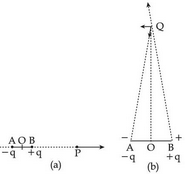
Figure for the question

Answer & explanation+

Correct answer: option 2

The correct answer is Option (2) → \( 1.33\times10^{5}\,\mathrm{N/C} \) along BA

The dipole is short (5 mm compared with 15 cm), so its field at distance r is \( E_{\mathrm{axial}} = \frac{2p}{4\pi\varepsilon_0 r^{3}} \) on the axis and \( E_{\mathrm{equatorial}} = \frac{p}{4\pi\varepsilon_0 r^{3}} \) on the perpendicular bisector. The equatorial field is half the axial field at the same distance, and it is opposite in direction to the dipole moment \( \vec{p} \), which points from \( -q \) (A) to \( +q \) (B).

Magnitude

    \( E_{\mathrm{eq}} = \frac{1}{2}E_{\mathrm{ax}} = \frac{2.66\times10^{5}}{2}\,\mathrm{N/C} = 1.33\times10^{5}\,\mathrm{N/C} \)

Direction

At P, on the side of the positive charge, the axial field is along AB, that is along \( \vec{p} \). The equatorial field is opposite to \( \vec{p} \), so it points along BA.

Note: This question is from NCERT (2026-27). NTA sets numerical questions from NCERT too, so do not ignore NCERT while practising numericals.

NCERT (2026-27):
The Field of an Electric Dipole – …

Textbook extract

Advertisement

Practise more on Electric Charges and Fields

Chapter-wise mocks on the real NTA exam screen, with solutions and your rank. Your first mocks are free.

Start free mocks →

Advertisement

Next questions

  1. Find the sum of all the natural numbers from 21 to 50.General Aptitude Test · Quantitative Reasoning
  2. Which traveller saw "crown ownership of land as being harmful for both the state and its people"?History · Medieval India: Through the Eyes of Travellers
  3. Raven's Progressive Matrices Test is an example of ___________.Psychology · Variations in Psychological Attributes
  4. Two different positions of the same dice are shown, the six faces of which are numbered from 1 to 6. Select the number that will be on the…General Aptitude Test · Verbal Reasoning
  5. Select the option in which the numbers share the same relationship as that shared by the given pair of numbers. 72 : 14General Aptitude Test · General Ability
  6. Select the INCORRECTLY spelt word.English · Spelling Check
  7. The domain of the function f(x)=(√(2x-1)+√(4x+7))/(√(4-x)+√(3+17x)) is:Maths. Section A · Relations and Functions
  8. Contents of the Partnership Deed does not include...Accountancy Part A · Accounting for Partnership
  9. Observe the image and answer the following question.Who painted the painting in the image, Dara Shikoh with Sages in a Garden?Fine Arts · The Mughal School of Miniature Painting
  10. The device that can act as a complete electronic circuit isPhysics · Semiconductors and Electronic Devices