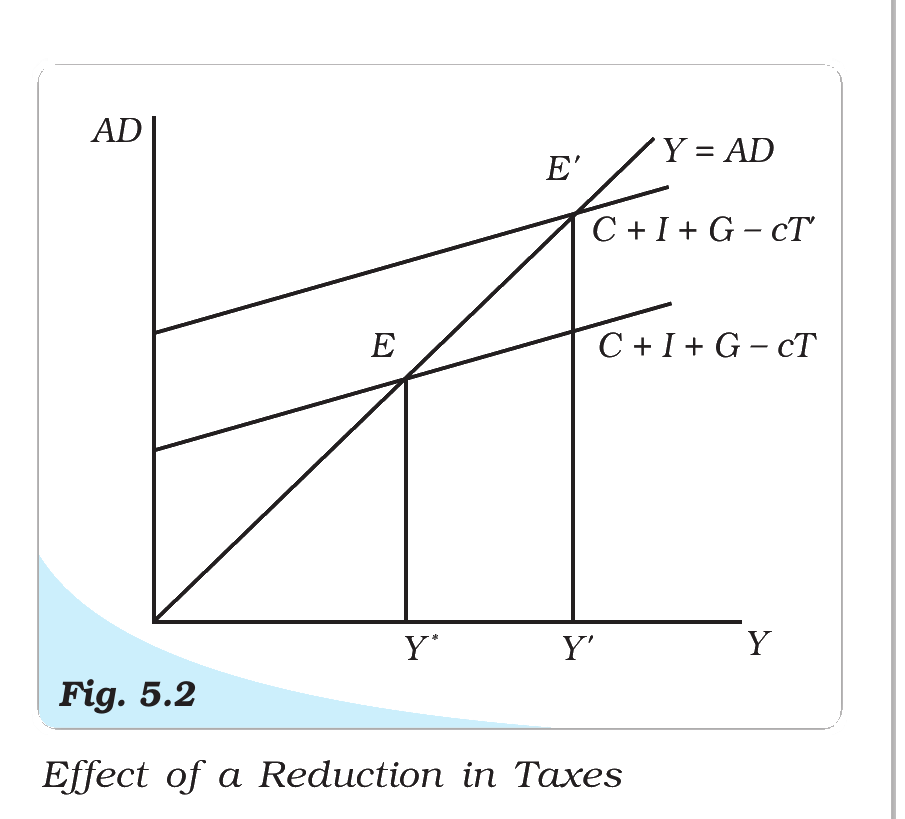
Arrange the following steps in proper sequence with respect to the change in taxes:
A. Decrease in taxes.
B. Shift the aggregate expenditure curve upwards.
C. Increase in disposable income.
D. Negative tax multiplier effect.
Choose the correct answer from the options given below:
Answer & explanation
Correct answer: option 1
The correct answer is Option (1) → A, C, D, B
Disposable income is what households have left to spend or save after paying taxes. Out of each extra rupee of it they spend a fraction, the marginal propensity to consume (c), and save the rest; what one household spends becomes another’s income, which is partly spent again, round after round. A change in taxes works through this chain:
A tax cut raises disposable income, so consumption and then income rise.
A tax rise lowers disposable income, so consumption and income fall.
Because taxes and income move in opposite directions, the tax multiplier is negative: −c/(1 − c). The chain starts with the policy and ends with higher planned spending at every level of income:
(A) Decrease in taxes. The policy measure, and the only item that is a cause rather than a consequence.
(C) Increase in disposable income. Its immediate effect: with a smaller tax bill, households keep more of what they earn.
(D) Negative tax multiplier effect. The mechanism that carries the extra spending through the economy, round after round, so that the tax cut raises income.
(B) Shift the aggregate expenditure curve upwards. The outcome: planned spending is higher at every level of income, so equilibrium income is higher.
NCERT (2025-26): “Changes in Taxes We find that a cut in taxes increases disposable income (Y – T ) at each level of income. This shifts the aggregate expenditure schedule upwards by a fraction c of the decrease in taxes. This is shown in Fig 5.2. From equation 5.3, we can calculate the tax multiplier using the same method as for the government expenditure multiplier. The tax multiplier … Because a tax cut (increase) will cause an increase (reduction) in consumption and output, the tax multiplier is a negative multiplier.…”
|