
CUETMOCK
  • Pricing
  • Mentors
Log inStart freeStart free mocks→

First test, then trust

Try a free CUET mock test.

Join 5,00,000+ students who rehearsed exam day on the exact NTA screen before sitting CUET. On the web and on Android.

Start free mocks →Get the Android app
CUETMOCK

India's #1 CUET Mock Test Platform. Original NCERT-based questions on the exact NTA exam screen — trusted by 5,00,000+ students since CUET 2022.

Get it onGoogle PlayScan to download the CUETMOCK app

Mock tests

  • CUET mock test series
  • Browse all papers
  • Commerce mocks
  • Humanities (Arts) mocks
  • Science mocks
  • Languages & GAT mocks
  • Free practice questions
  • Pricing

Resources

  • CUET exam guide
  • CUET syllabus
  • Universities accepting CUET
  • Expert blogs
  • News & notifications
  • Webinars & counselling
  • CUET score calculator
  • How we estimate your rank
  • FAQs

Company

  • About us
  • Our leadership & team
  • Our toppers
  • Mentors
  • For schools
  • Contact us
  • Terms
  • Privacy
  • Refund policy

Talk to us

+91 7696 6630 56info@cuetmock.comWhatsApp us

Our other platforms

  • JEE Mock — For IIT-JEE aspirants
  • NEET Mock — For NEET aspirants

Newsletter

Exam updates, study material and offers — no spam.

© 2026 NYC Ventures Pvt. Ltd.

701-702, Royal Business Park, Zirakpur, Punjab - 140603

  • Terms of use
  • Privacy policy
  • Refund policy
  • Contact us

iCUETMOCK is an independent preparation platform, not affiliated with the National Testing Agency (NTA). Always check exam details on the official NTA website.

  • Home
  • Mock tests
  • CUET guide
  • Pricing
  • Log in
Home/Practice questions/Chemistry
ChemistryPhysical: Chemical Kinetics

For a bimolecular elementary reaction between A and B, the rate of re…

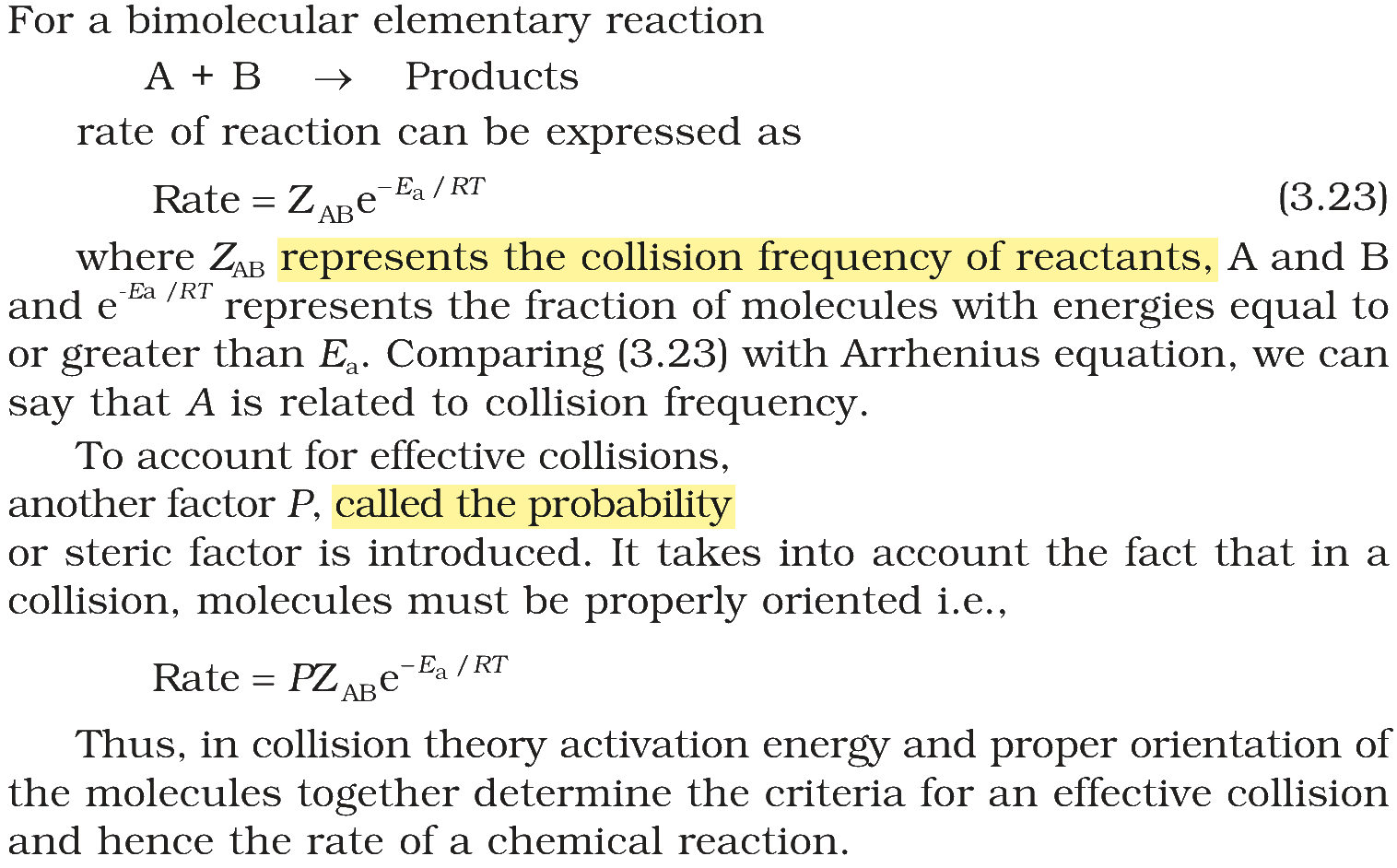
For a bimolecular elementary reaction between A and B, the rate of reaction is expressed as

\( rate=P.Z_{AB}e^{(-\frac{E_a}{RT})} \)

Identify the terms \( P, Z_{AB} \) and \( E_a \) involved in this expression, respectively

Answer & explanation+

Correct answer: option 3

The correct answer is Option (3) → Probability factor, collision frequency, Activation energy

In the collision theory, \( Z_{AB} \) is the collision frequency, \( E_a \) the activation energy, and P the probability (steric) factor that allows for the orientation of the colliding molecules.

Why the other options are incorrect

  • Option (1) Probability factor, collision number, Absolute energy — Incorrect. \( Z_{AB} \) is a rate of collisions (per second per unit volume), not just a number, and there is no “absolute energy” in the expression.

  • Option (2) Pressure, collision number, Activation energy — Incorrect. P here is the probability (steric) factor, not pressure.

  • Option (4) Pressure, collision frequency, Absolute energy — Incorrect. Both P and \( E_a \) are misnamed: they are the probability factor and the activation energy.

NCERT (2026-27 edition):
Collision Theory of Chemical Reactions – …
Textbook extract

Advertisement

Practise more on Physical: Chemical Kinetics

Chapter-wise mocks on the real NTA exam screen, with solutions and your rank. Your first mocks are free.

Start free mocks →

Advertisement

Next questions

  1. The conditional probability that his answer is correct when it is given that he knew it :Maths. Section B1 · Probability
  2. Find the odd one out:General Aptitude Test · Verbal Reasoning
  3. In a row, Rahul is 13th from left end if he is 21th from Right end, then how many persons are there in the now ?General Aptitude Test · Verbal Reasoning
  4. 'इत्यादि' का उपयुक्त संधि विच्छेद है:Hindi · व्याकरण - सन्धि
  5. Which of the following is NOT a feature of financial statements?Accountancy Part B · Financial Statements of a Company
  6. Find the critical value for α = 0.05 with df = 16 for a right tailed (upper tailed) test.Applied Maths. Section B2 · Inferential Statistics
  7. Select the option that is related to the third number in the same way as the second number is related to the first number. 735 : 612 :: 476…General Aptitude Test · General Ability
  8. Under the DSM-5 classification of commonly abused substances, which of the following fall in the category of sedatives, hypnotics or anxiol…Psychology · Psychological Disorders
  9. Which of the following is not a technique of controlling?Business Studies · Controlling
  10. If 5 students utilise 18 pens in 9 days, how long at the same rate, will 66 pens last for 15 students?General Aptitude Test · Numerical Ability