
A furniture trader deals in only two items-chairs and tables. He has ₹50000 to invest and a space to store atmost 35 items. A chair costs him ₹1000 and a table costs him ₹2000. The trader earns a profit of ₹150 and ₹250 on a chair and a table, respectively. Formulate the above problem as an L.P.P. to maximise the profit and solve it graphically.
Answer & explanation
Correct answer: option 1
The correct answer is Option (1) → 6750
Let $x$ be the number of chairs and $y$ be the number of tables.
- Objective Function: We want to maximize the total profit $Z$.
$Z = 150x + 250y$
- Investment Constraint: The total cost cannot exceed ₹50,000.
$1000x + 2000y \leq 50000$ (which simplifies to $x + 2y \leq 50$)
- Storage Constraint: The total number of items cannot exceed 35.
$x + y \leq 35$
- Non-negativity Constraints: You cannot have a negative number of items.
$x \geq 0, y \geq 0$
Identify the Boundary Lines
We find the intercepts for the two main constraint lines:
- Line 1 ($x + 2y = 50$):
- If $x = 0, y = 25$. Point: (0, 25)
- If $y = 0, x = 50$. Point: (50, 0)
- Line 2 ($x + y = 35$):
- If $x = 0, y = 35$. Point: (0, 35)
- If $y = 0, x = 35$. Point: (35, 0)
Find the Intersection Point
To find where the lines cross, solve the system:
- $x + 2y = 50$
- $x + y = 35 ⇒x = 35 - y$
Substitute $x$ into the first equation:
$(35 - y) + 2y = 50$
$35 + y = 50$
$y = 15$
Substitute $y$ back:
$x + 15 = 35 ⇒$ $x = 20$
The intersection point is (20, 15).
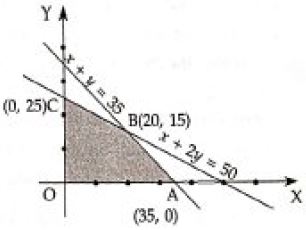
The shaded portion shows the feasible region which is bounded. The point of intersection of the lines $x+y=35$ and $x+2y=50$ is B(20,15).
The four corner points of the feasible region OABC are $O(0,0),A(35,0),B(20,15)$ and $C(0,25)$.
At $(0,0),P=150×0+250×0=0$.
At $A(35,0),P=150×35+250×0=5250$.
At $B(20,15),P=150×20+250×15=6750$.
At $C(0,25),P=150×0+250×25=6250$.
We find that P is maximum at B(20, 15) and maximum value of P = 6750. Hence, the dealer gets maximum profit of ₹6750 when he buys and sells 20 chairs and 15 tables.