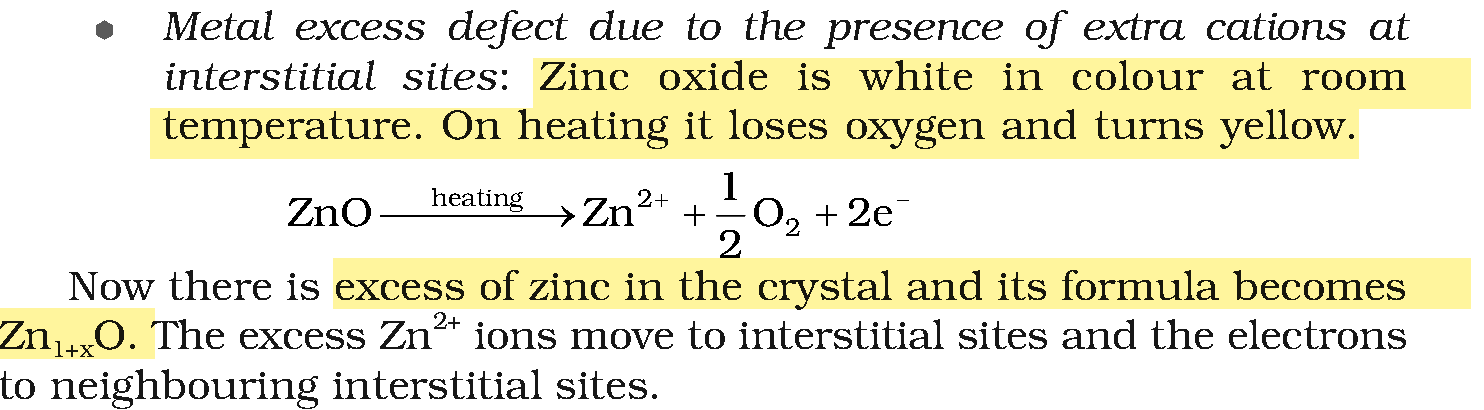
Zinc oxide is white in colour at room temperature. It appears yellow on heating because of:
Answer & explanation
Correct answer: option 3
The correct answer is Option (3) → Metal excess defect
A metal excess defect can arise when extra cations occupy interstitial sites, with an equal number of electrons in neighbouring interstitial sites to keep the crystal neutral. Electrons trapped in this way absorb visible light, so the crystal becomes coloured.
In zinc oxide the extra \( \ce{Zn^{2+}} \) ions formed on heating sit in interstitial sites and the released electrons occupy neighbouring interstitial sites. These electrons give hot zinc oxide its yellow colour.
Why the other options are incorrect
Option (1) Frenkel defect — Incorrect. An ion (usually the smaller cation) only shifts from its lattice site to an interstitial site; the composition stays ZnO and no electrons are trapped, so it does not cause colour.
Option (2) Schottky defect — Incorrect. Equal numbers of cations and anions are missing; it lowers the density but leaves the crystal stoichiometric and colourless.
Option (4) Metal deficiency defect — Incorrect. Here the solid has less metal than the ideal formula (e.g. Fe0.95O); heating ZnO gives the opposite, an excess of zinc.
Note: This question is from the pre-rationalised NCERT book (2022-23). The topic is not there in the latest NCERT book (2026-27), and it is also out of the CUET 2026 syllabus.
NCERT (Pre-rationalised edition, 2022-23):
Metal Excess Defect – …