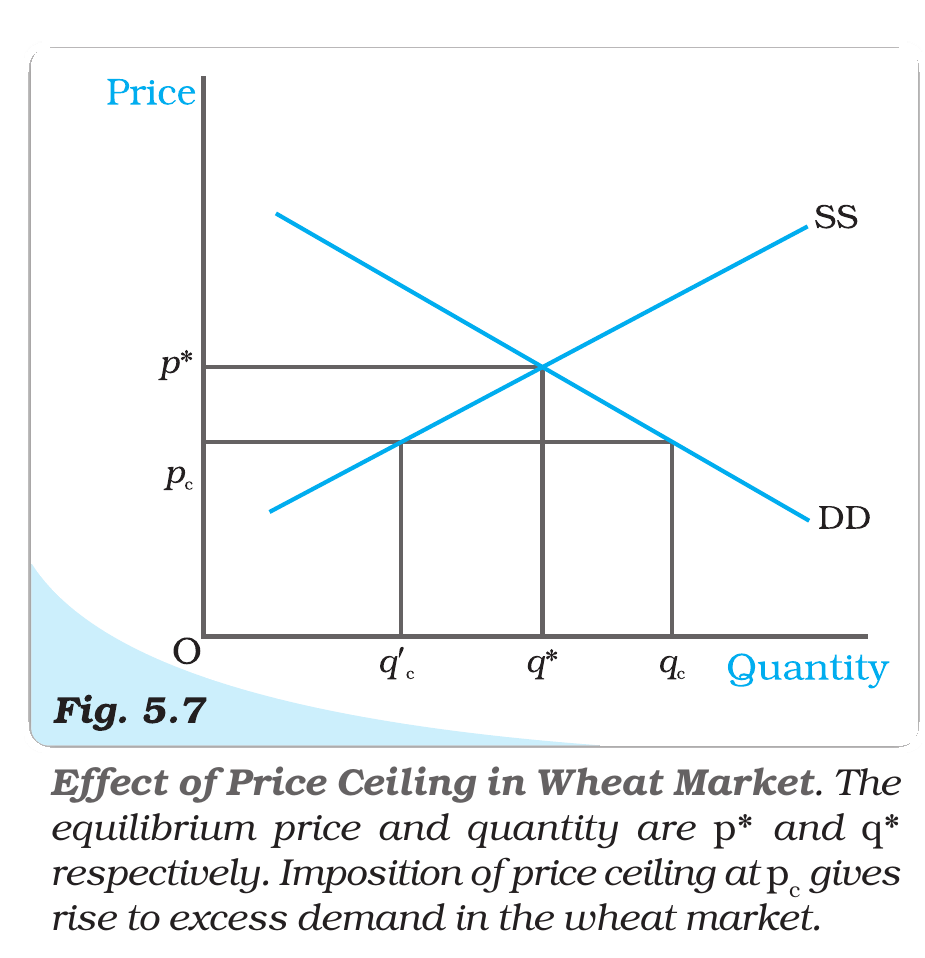
If the government fixed maximum price of product below the market price then product will have?
Answer & explanation
Correct answer: option 3
The correct answer is Option (3) → Excess Demand.
A maximum price fixed by the government is called a price ceiling. When it is set below the market price, the good becomes cheaper than it would be at equilibrium.
At the lower price, consumers want to buy more of the good.
At the same price, firms want to sell less of it.
The quantity demanded is then greater than the quantity supplied. This gap is excess demand.
NCERT (2026-27): “5.2.1 Price Ceiling … It is not very uncommon to come across instances where government fixes a maximum allowable price for certain goods. The government-imposed upper limit on the price of a good or service is called price ceiling. Price ceiling is generally imposed on necessary items like wheat, rice, kerosene, sugar and it is fixed below the market-determined price since at the market-determined price some section of the population will not be able to afford these goods.… …Figure 5.7 shows the market supply curve SS and the market demand curve DD for wheat. The equilibrium price and quantity of wheat are p* and q* respectively. When the government imposes price ceiling at pc which is lower than the equilibrium price level, there will be an excess demand for wheat in the market at that price. The consumers demand qc kilograms of wheat whereas the firms supply qc' kilograms. Hence, though the intention of the government was to help the consumers, it could end up creating shortage of wheat.…”
|