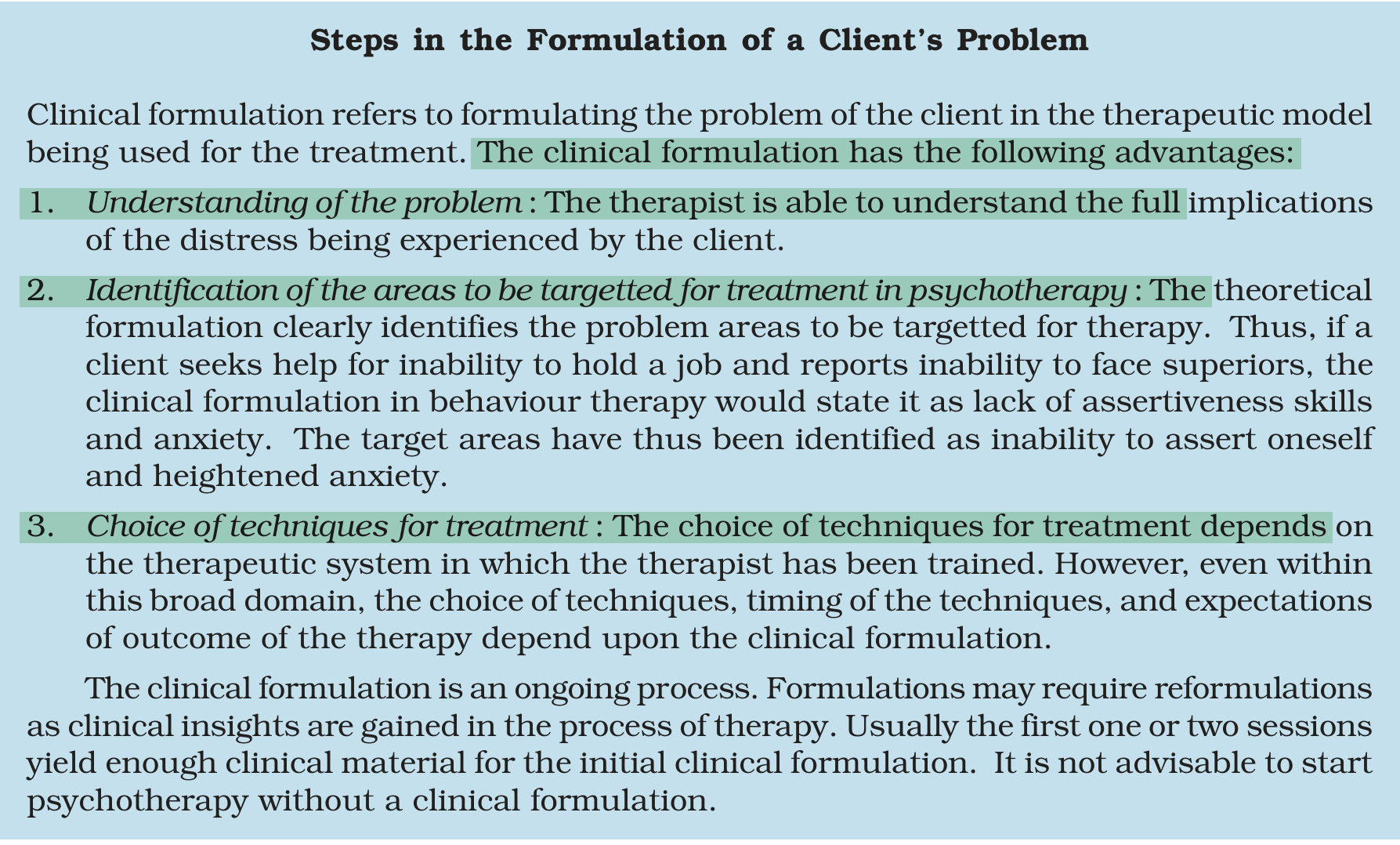
Sunita, a 30-year-old bank clerk in Lucknow, seeks help because she cannot speak up at meetings and feels intense anxiety before meeting her manager. In the first two sessions, her behaviour therapist interviews her and her family members. The therapist then puts Sunita's problem into the terms of behaviour therapy, and notes that this statement may be revised as the sessions go on.
The therapist's statement of Sunita's problem in the model of behaviour therapy gives which of the following advantages?
(A) Understanding of the problem
(B) Identification of the problem areas to be targeted in therapy
(C) Choice of techniques for treatment
(D) Eliciting her intrapsychic conflicts through free association
Choose the correct answer from the options given below:
Answer & explanation
Correct answer: option 1
The correct answer is Option (1) → A, B and C only
(A) Understanding of the problem — Correct. Stating the problem in the therapy's own model is clinical formulation, and its first gain is that the therapist grasps the full implications of the distress.
(B) Identification of the problem areas to be targeted in therapy — Correct. The formulation marks the problem areas to be targetted: for a client who cannot face superiors these are inability to assert oneself and heightened anxiety.
(C) Choice of techniques for treatment — Correct. The choice of techniques, their timing and the expected outcome of therapy depend on the clinical formulation, within the therapeutic system the therapist is trained in.
(D) Eliciting her intrapsychic conflicts through free association — Incorrect. Eliciting intrapsychic conflicts through free association is the method of psychodynamic therapy, and the statement instead attaches it to a behaviour therapist, whose work is on present behaviour.
NCERT (2026-27):
|