
The table gives the concentration of butyl chloride at different times during its hydrolysis, \( \ce{C4H9Cl + H2O -> C4H9OH + HCl} \). No C4H9OH is present at the start.
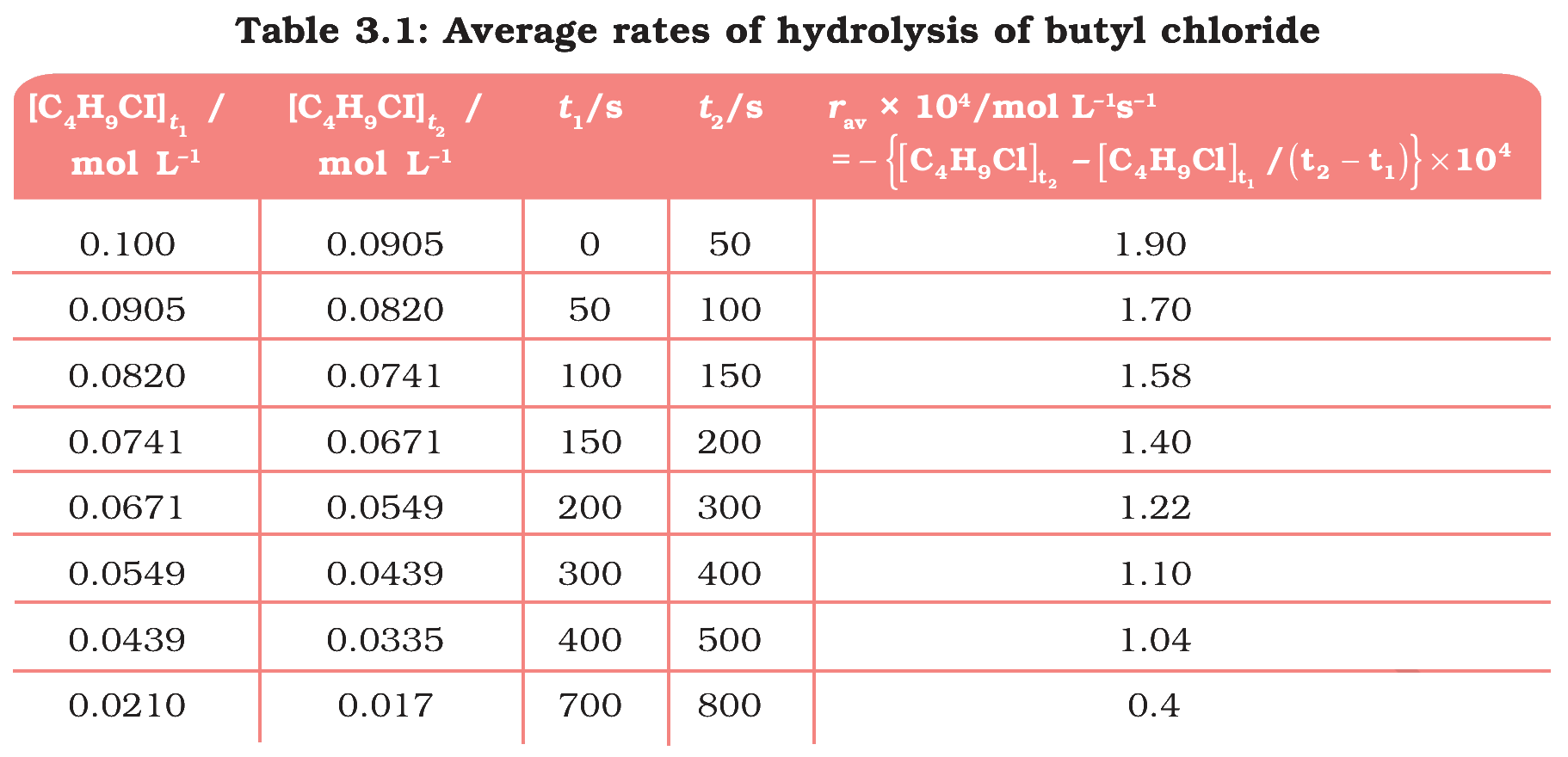
What is the concentration of C4H9OH at t = 400 s?
Answer & explanation
Correct answer: option 1
The correct answer is Option (1) → 0.0561 mol L−1
In the equation, one mole of C4H9Cl gives one mole of C4H9OH, so the C4H9OH formed equals the C4H9Cl used up. From the table, [C4H9Cl] is 0.100 mol L−1 at t = 0 s and 0.0439 mol L−1 at t = 400 s.
\( \displaystyle [\ce{C4H9OH}]_{400\,s} = 0.100 - 0.0439 = 0.0561\ \mathrm{mol\,L^{-1}} \)
NCERT (2026-27 edition):
3.1 Rate of a Chemical Reaction – “Where stoichiometric coefficients of the reactants and products are same, then rate of reaction is given as … i.e., rate of disappearance of any of the reactants is same as the rate of appearance of the products.”
Table 3.1: Average rates of hydrolysis of butyl chloride