The product in the following reaction is

Answer & explanation
Correct answer: option 1
The correct answer is Option (1) → N-phenylbenzenesulphonamide (\( \ce{C6H5SO2NHC6H5} \))
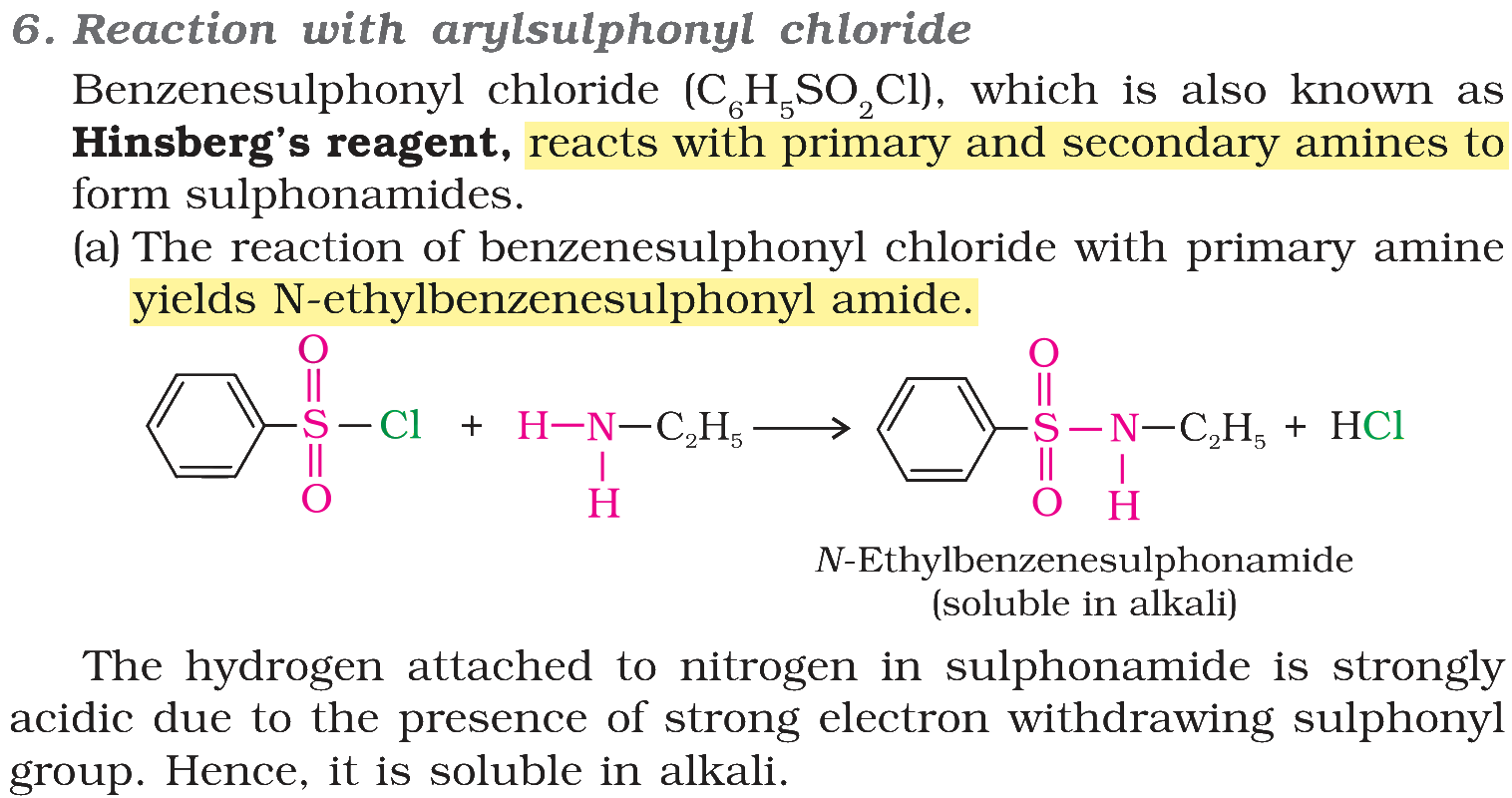
Benzenesulphonyl chloride, \( \ce{C6H5SO2Cl} \) (Hinsberg’s reagent), reacts with primary and secondary amines: the N–H hydrogen of the amine and the Cl of the reagent leave as HCl, and an S–N bond forms, giving a sulphonamide. Tertiary amines have no N–H hydrogen and do not react.
Aniline is a primary amine:
\( \displaystyle \ce{C6H5NH2 + C6H5SO2Cl -> C6H5SO2NHC6H5 + HCl} \)
So Y is N-phenylbenzenesulphonamide. Its N–H hydrogen is acidic because of the strongly electron-withdrawing sulphonyl group, so the product dissolves in alkali; this is how a primary amine is told apart from a secondary amine in the Hinsberg test.
Why the other options are incorrect
Option (2) diphenylamine — Incorrect. It has two phenyl groups joined directly to nitrogen; the sulphonyl group cannot be lost from the product to give it.
Option (3) a structure with an S–N bond but no oxygen on sulphur — Incorrect. The two oxygen atoms of the \( \ce{SO2} \) group stay in the product; only Cl is replaced.
Option (4) benzenesulphonic acid and anilinium chloride — Incorrect. This would need water to hydrolyse the reagent; with aniline the reagent forms the sulphonamide.
NCERT (2026-27 edition):
Reaction with Arylsulphonyl Chloride