
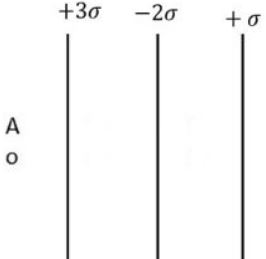
In the figure, there are three infinitely long thin sheets having surface charge density \( +3\sigma \), \( -2\sigma \) and \( +\sigma \) respectively. Determine magnitude and direction of the electric field at point A.
Answer & explanation
Correct answer: option 4
The correct answer is Option (4) → \( \displaystyle\frac{\sigma}{\varepsilon_0} \) towards left
An infinite plane sheet of charge density \( \sigma \) gives a uniform field \( \sigma/2\varepsilon_0 \), directed away from a positive sheet and towards a negative one. The fields of the three sheets add by superposition.
Point A lies to the left of all three sheets. Take the field towards the right as positive.
\( +3\sigma \text{ sheet: } 3\sigma/2\varepsilon_0 \text{ towards the left (away from it)} \)
\( -2\sigma \text{ sheet: } 2\sigma/2\varepsilon_0 \text{ towards the right (towards it)} \)
\( +\sigma \text{ sheet: } \sigma/2\varepsilon_0 \text{ towards the left (away from it)} \)
\( \displaystyle E_A = \frac{-3\sigma + 2\sigma - \sigma}{2\varepsilon_0} = -\frac{2\sigma}{2\varepsilon_0} = -\frac{\sigma}{\varepsilon_0} \)
The magnitude is \( \sigma/\varepsilon_0 \), and the minus sign means the field points towards the left.
Shortcut: At a point outside all the sheets the field is \( (\text{total charge density})/2\varepsilon_0 \), pointing away from the sheets if the total is positive. Here the total is \( +3\sigma - 2\sigma + \sigma = +2\sigma \), so \( E = \sigma/\varepsilon_0 \), away from the sheets, that is towards the left at A.