What is the major product when benzoic acid reacts with Br2 and FeBr3?
Answer & explanation
Correct answer: option 2
The correct answer is Option (2) → m-Bromobenzoic acid
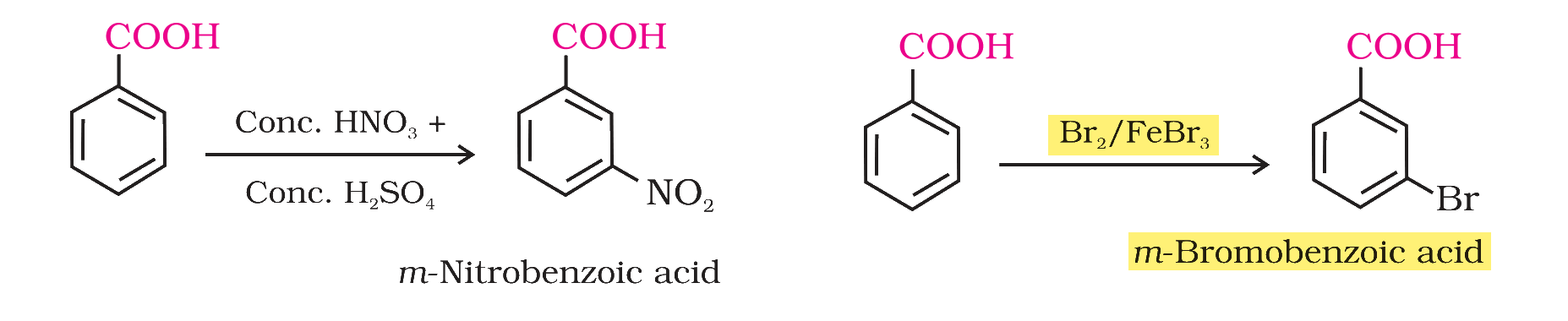
Br2 with FeBr3 brings about electrophilic substitution on the benzene ring. The –COOH group withdraws electrons from the ring, so it deactivates the ring and directs the incoming bromine to the meta position:
\( \displaystyle \ce{C6H5COOH + Br2} \xrightarrow{\ce{FeBr3}} \ce{BrC6H4COOH + HBr} \)
The bromine enters at C-3, meta to –COOH, giving m-bromobenzoic acid.
Why the other options are incorrect
Option (1) o-Bromobenzoic acid — Incorrect. The ortho position would be the main site only for an ortho/para-directing group; –COOH is meta-directing.
Option (3) p-Bromobenzoic acid — Incorrect. For the same reason, the para position is not the main site of attack.
Option (4) 2,4,6-Tribromobenzoic acid — Incorrect. Substitution at three ortho/para positions at once is seen with strongly activating groups such as –OH in phenol; the deactivating –COOH group gives a single meta substitution.
NCERT (2026-27 edition):
2. Ring substitution – “Aromatic carboxylic acids undergo electrophilic substitution reactions in which the carboxyl group acts as a deactivating and meta-directing group.”