What does dumping mean in international trade?
Answer & explanation
Correct answer: option 2
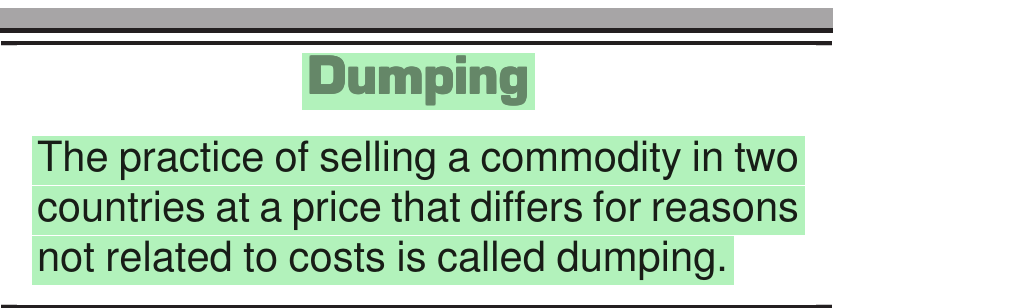
The correct answer is Option (2) → It means selling a commodity in two countries at a price that differs for reasons not related to costs.
Option (1) It means exporting goods to a non-World Trade Organisation member country. — Incorrect. Dumping turns on the price of the goods, not on whether the buying country belongs to the WTO.
Option (2) It means selling a commodity in two countries at a price that differs for reasons not related to costs. — Correct. This is the meaning of dumping. A firm sells the same commodity more cheaply in another country, though its costs give no reason for the lower price. Local producers there cannot match that price and lose their buyers, so dumped goods of cheaper prices can harm the domestic producers.
Option (3) It means throwing away goods that do not conform to quality checks by the importing country. — Incorrect. Dumped goods are sold in the other market at a lower price, not thrown away.
Option (4) It means selling a good quality commodity to another country. — Incorrect. That is ordinary export; dumping is a price difference that costs do not explain.
Note: A similar question was also asked in CUET (UG) 2026 on 20-05-2026 (Slot 1).
NCERT (2025-26): “Case for Free Trade … Countries also need to be cautious about dumped goods; as along with free trade dumped goods of cheaper prices can harm the domestic producers.”
|