For light nuclei such as hydrogen, deuterium and tritium, what can you say about the binding energy per nucleon?
Answer & explanation
Correct answer: option 3
The correct answer is Option (3) → It is small.
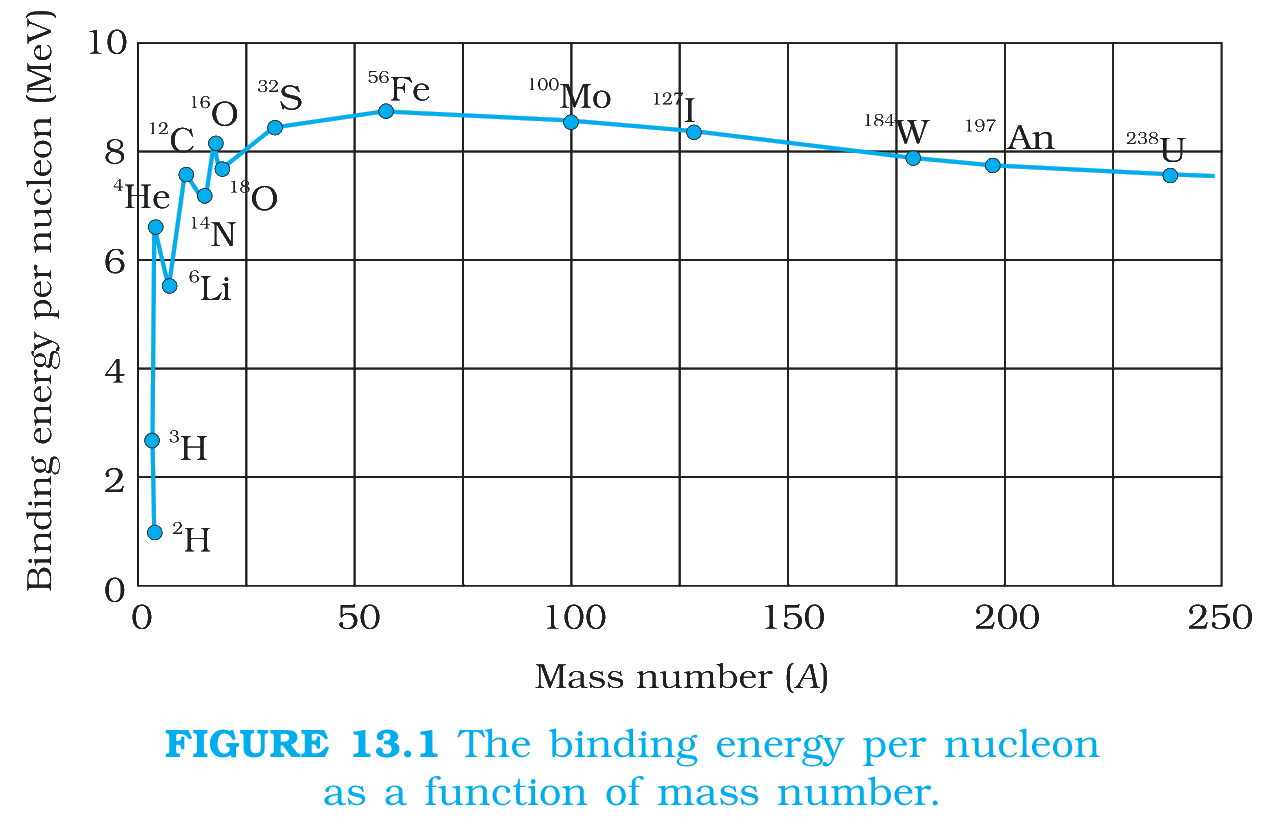
The binding energy per nucleon \( E_{bn}=E_b/A \) is nearly constant, about 8 MeV, for nuclei of middle mass number (\( 30\lt A\lt170 \)). It is lower for light nuclei (\( A\lt30 \)).
Option (1) It is very high. — Incorrect. The highest values, about 8.75 MeV, belong to nuclei near A = 56. The isotopes of hydrogen lie at the very start of the binding energy curve.
Option (2) It is higher than that of \( {}^{16}\mathrm{O} \). — Incorrect. From Fig. 13.1, \( {}^{16}\mathrm{O} \) lies near 8 MeV, while \( {}^{2}\mathrm{H} \) and \( {}^{3}\mathrm{H} \) lie at only about 1 MeV and below 3 MeV.
Option (3) It is small. — Correct. With A = 1 to 3 these are the lightest nuclei, where the curve starts low and rises steeply. The ordinary hydrogen nucleus is a single proton and has no binding energy at all. Deuterium and tritium are only loosely bound.
Option (4) It cannot be predicted. — Incorrect. The binding energy of any nucleus follows from its mass defect, \( E_b=\Delta M\,c^{2} \). Dividing it by A gives \( E_{bn} \), and the binding energy curve shows it for the light nuclei too.
NCERT (2026-27):
Nuclear Binding Energy – “(ii) Ebn is lower for both light nuclei (A<30) and heavy nuclei (A>170).”