Antipyretic drugs prevent platelet coagulation, apart from reducing fever. Because of this action, antipyretic aspirin is also used:
Answer & explanation
Correct answer: option 1
The correct answer is Option (1) → in the prevention of heart attack
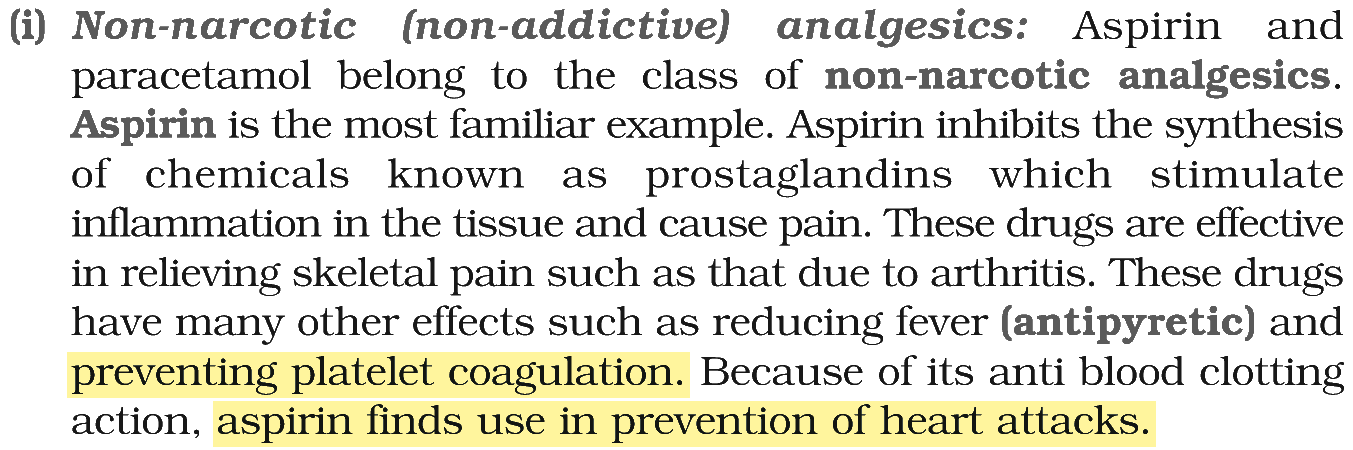
Aspirin (acetylsalicylic acid) is a non-narcotic analgesic. It inhibits the synthesis of prostaglandins, so it relieves pain and lowers fever (antipyretic). It also prevents platelet coagulation, that is, it has an anti blood clotting action. A clot blocking a coronary artery is what causes a heart attack, so low doses of aspirin are used in the prevention of heart attacks.
Why the other options are incorrect
Option (2) as an antacid — Incorrect. Aspirin is itself an acid and can irritate the stomach lining; antacids are bases such as magnesium hydroxide or drugs such as ranitidine.
Option (3) as anti-histamine — Incorrect. Antihistamines such as brompheniramine and terfenadine block histamine receptors; aspirin does not.
Option (4) as tranquilizer — Incorrect. Tranquilizers such as equanil and barbiturates act on the nervous system to relieve stress; aspirin has no such action.
Note: This question is from the pre-rationalised NCERT book (2022-23). The topic is not there in the latest NCERT book (2026-27), and it is also out of the CUET 2026 syllabus.
NCERT (Pre-rationalised edition, 2022-23):
Non-Narcotic (Non-Addictive) Analgesics