CUETMOCK
  • Pricing
  • Mentors
Log inStart freeStart free mocks→

First test, then trust

Try a free CUET mock test.

Join 5,00,000+ students who rehearsed exam day on the exact NTA screen before sitting CUET. On the web and on Android.

Start free mocks →Get the Android app
CUETMOCK

India's #1 CUET Mock Test Platform. Original NCERT-based questions on the exact NTA exam screen — trusted by 5,00,000+ students since CUET 2022.

Get it onGoogle PlayScan to download the CUETMOCK app

Mock tests

  • CUET mock test series
  • Browse all papers
  • Commerce mocks
  • Humanities (Arts) mocks
  • Science mocks
  • Languages & GAT mocks
  • Free practice questions
  • Pricing

Resources

  • CUET exam guide
  • CUET syllabus
  • Universities accepting CUET
  • Expert blogs
  • News & notifications
  • Webinars & counselling
  • CUET score calculator
  • How we estimate your rank
  • FAQs

Company

  • About us
  • Our leadership & team
  • Our toppers
  • Mentors
  • For schools
  • Contact us
  • Terms
  • Privacy
  • Refund policy

Talk to us

+91 7696 6630 56info@cuetmock.comWhatsApp us

Our other platforms

  • JEE Mock — For IIT-JEE aspirants
  • NEET Mock — For NEET aspirants

Newsletter

Exam updates, study material and offers — no spam.

© 2026 NYC Ventures Pvt. Ltd.

701-702, Royal Business Park, Zirakpur, Punjab - 140603

  • Terms of use
  • Privacy policy
  • Refund policy
  • Contact us

iCUETMOCK is an independent preparation platform, not affiliated with the National Testing Agency (NTA). Always check exam details on the official NTA website.

  • Home
  • Mock tests
  • CUET guide
  • Pricing
  • Log in
Home/Practice questions/Economics
EconomicsMicro Economics: Theory of Consumer behaviour

The expenditure on the good would change in the opposite direction as…

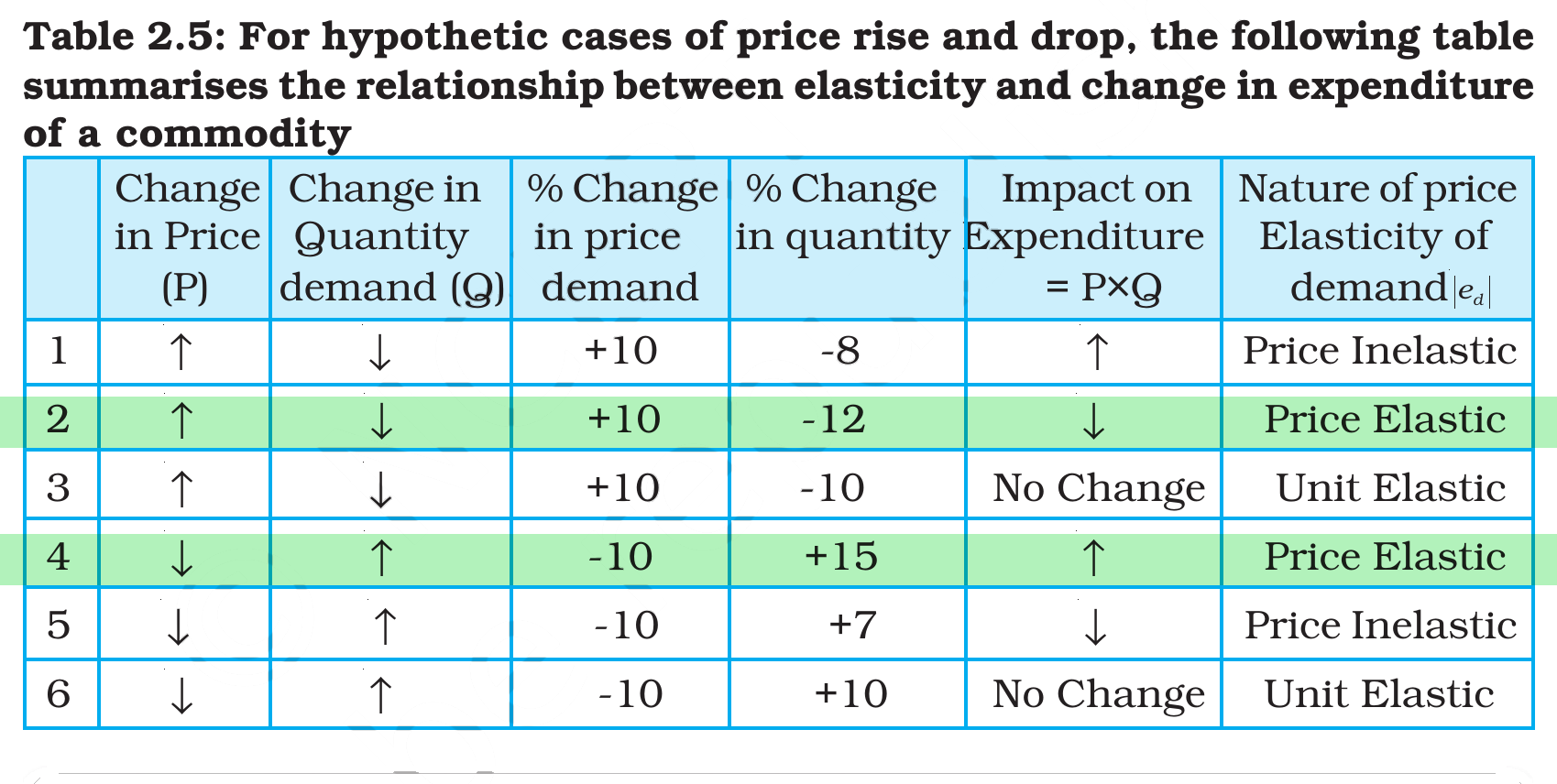
The expenditure on the good would change in the opposite direction as the price change if and only if:

Answer & explanation+

Correct answer: option 2

The correct answer is Option (2) → The percentage change in quantity demanded is greater than the percentage change in price.

The expenditure on a good is its price multiplied by the quantity bought. When the price changes, the quantity demanded moves the other way, so the two parts of expenditure pull in opposite directions, and expenditure follows whichever of them changes by the larger percentage. How strongly quantity responds to price is measured by the price elasticity of demand: the percentage change in quantity demanded divided by the percentage change in price, taken without its minus sign. This gives three cases:

  • Elastic demand (elasticity greater than 1): quantity changes by a larger percentage than price, so expenditure moves opposite to the price. If the price rises by 10 per cent and the quantity demanded falls by 20 per cent, expenditure falls.

  • Unitary elastic demand (elasticity equal to 1): the two changes cancel, and expenditure stays the same.

  • Inelastic demand (elasticity less than 1): quantity changes by a smaller percentage than price, so expenditure moves in the same direction as the price.

Expenditure moves opposite to the price only in the first case, when the percentage change in quantity demanded is greater than the percentage change in price.

Why the other options are incorrect

  • Option (1) The percentage change in quantity demanded is less than the percentage change in price. — Incorrect. This is inelastic demand: expenditure moves with the price.

  • Option (3) The percentage change in quantity demanded is equal to the percentage change in price. — Incorrect. This is unitary elastic demand: expenditure does not change.

  • Option (4) There is no change in quantity demanded with the change in price. — Incorrect. Demand is then perfectly inelastic: the quantity stays fixed, so expenditure rises or falls with the price.


NCERT (2025-26): “2.6.3 Elasticity and Expenditure … The expenditure on a good is equal to the demand for the good times its price. Often it is important to know how the expenditure on a good changes as a result of a price change. The price of a good and the demand for the good are inversely related to each other. Whether the expenditure on the good goes up or down as a result of an increase in its price depends on how responsive the demand for the good is to the price change. Consider an increase in the price of a good. If the percentage decline in quantity is greater than the percentage increase in the price, the expenditure on the good will go down. For example, see row 2 in table 2.5 which shows that as price of a commodity increases by 10%, its demand drops by 12%, resulting in a decline in expenditure on the good.…”

NCERT extract

Advertisement

Practise more on Micro Economics: Theory of Consumer behaviour

Chapter-wise mocks on the real NTA exam screen, with solutions and your rank. Your first mocks are free.

Start free mocks →

Advertisement

Next questions

  1. What is not a consequence of the collapse of Soviet Union and the socialist systems in Eastern Europe for world politics?Political Science · Contemporary World Politics: End of Bi-Polarity
  2. The alloy is-(A) mixture of two or more metals(B) a mixture of a metal and a non-metal(C) cannot be separated into their components by phys…General Aptitude Test · General Knowledge
  3. A long wire having linear mass density of 0.25 g/cm, carrying a current of 5 A, is to be suspended in air in the magnetic field created aro…Physics · Moving Charges and Magnetism
  4. Mr. ‘A’, is working in a Multinational Company (MNC). He is always in a great hurry, possesses high motivation, feels short of time. Identi…Psychology · Self and Personality
  5. The wavelength of the first line of Lyman series of hydrogen is 121.6 nm . The wavelength of the third line of the same series will bePhysics · Atoms
  6. What was the relation between the ruling Congress party and the opposition parties in the first decade of electoral politics?Political Science · Politics in India Since Independence: Era of one Party Dominance
  7. Match the LIST-I with LIST-IILIST-ILIST-IIDiseasesSymptomsA. PneumoniaI. Constipation, abdominal pain, stools with excess mucous and blood…Biology · Human Health and Disease
  8. The solution of the differential equation displaystyledy/dx+y=1,y(1)=0 isMaths. Section A · Differential Equations
  9. Which leaders initially hesitated to create linguistic states?Sociology · Indian Society: Challenges of Cultural Diversity
  10. Which of the following statements is incorrect about the relationship between Average cost (AC) and Average variable cost (AVC)?Economics · Micro Economics: Production and Costs