The capital structure of Fin Ltd. purely consists of Equity Share Capital of ₹20,00,000 consisting of share of ₹10 each. Its EBIT for the previous year was ₹3,00,000. Now it is planning to expand its business operations for which additional fund of ₹10,00,000 for replacement of old machines with modern machinery was needed. The company plans to raise the funds by issuing 10% Debentures of ₹100 each. Assuming the return on investment of the company remain unchanged, what will be the EPS if 10% Debentures of ₹10,00,000 are issued and tax rate is 40%.
Answer & explanation
Correct answer: option 2
The correct answer is Option (2) → ₹1.05
Step 1: Return on investment (RoI) now
RoI = EBIT ÷ Total investment × 100 = ₹3,00,000 ÷ ₹20,00,000 × 100 = 15%
Step 2: New EBIT
Total funds after the issue = ₹20,00,000 + ₹10,00,000 = ₹30,00,000
RoI stays the same, so EBIT = 15% of ₹30,00,000 = ₹4,50,000
Step 3: EPS
Interest on 10% Debentures = 10% of ₹10,00,000 = ₹1,00,000
EBT (earnings before tax) = ₹4,50,000 − ₹1,00,000 = ₹3,50,000
Tax at 40% = ₹1,40,000
EAT (earnings after tax) = ₹3,50,000 − ₹1,40,000 = ₹2,10,000
Number of equity shares = ₹20,00,000 ÷ ₹10 = 2,00,000
EPS = EAT ÷ Number of equity shares = ₹2,10,000 ÷ 2,00,000 = ₹1.05
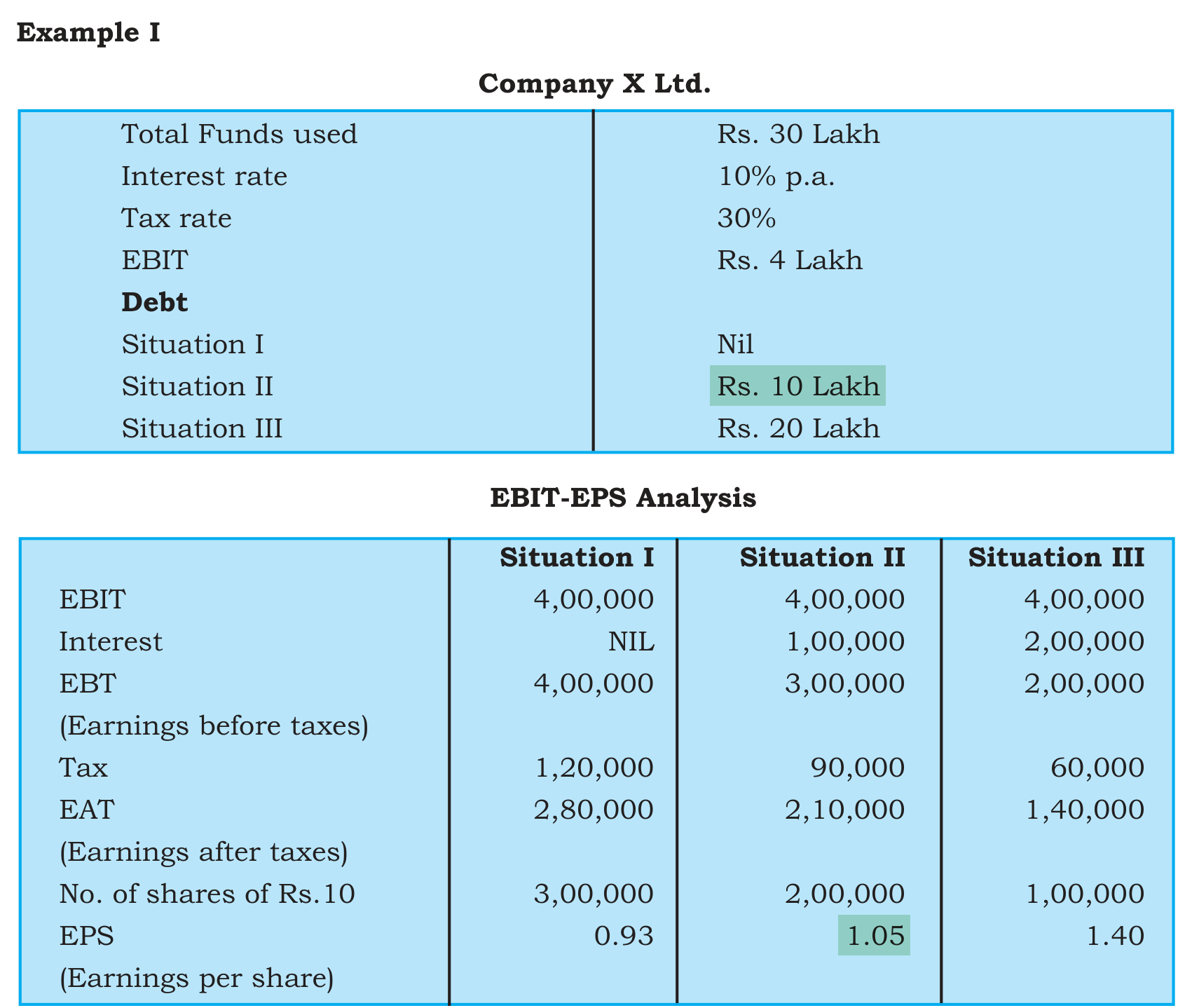
The EBIT-EPS table below works in the same way: EBIT, minus interest, minus tax, divided by the number of shares.
NCERT (2026-27 Edition): “EBIT-EPS Analysis … The impact of financial leverage on the profitability of a business can be seen through EBIT-EPS (Earning before Interest and Taxes-Earning per Share) analysis as in the following example.”
|