
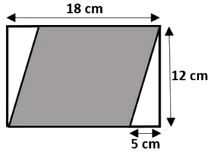
In the adjoining figure, a rectangle has dimensions of 18 cm × 12 cm. The area of the parallogram (shaded portion) is
Answer & explanation
Correct answer: option 3
The correct answer is Option (3) → $156\, cm^2$
Based on common geometry problems involving a rectangle of 18 cm × 12 cm with a shaded parallelogram inside, the parallelogram typically shares the same height as the rectangle.
Dimensions of the Rectangle:
- Length ($L$) = 18 cm
- Breadth ($B$) = 12 cm
- Total Area of Rectangle = $18 \times 12 = 216 \text{ cm}^2$
Dimensions of the Parallelogram (Shaded Region):
In this specific problem type, the parallelogram is usually formed by subtracting two congruent triangles from the corners. For the result to be 156 cm²:
- The base of the unshaded triangles at the corners is usually 5 cm each.
- The height of these triangles is the same as the rectangle's breadth (12 cm).
Calculation:
- Area of one unshaded triangle = $\frac{1}{2} \times \text{base} \times \text{height} = \frac{1}{2} \times 5 \times 12 = 30 \text{ cm}^2$
- Since there are two such triangles (one on each side of the shaded parallelogram):
Total Unshaded Area = $30 + 30 = 60 \text{ cm}^2$
- Area of Shaded Parallelogram = Total Area - Unshaded Area
$\text{Area} = 216 \text{ cm}^2 - 60 \text{ cm}^2 = 156 \text{ cm}^2$