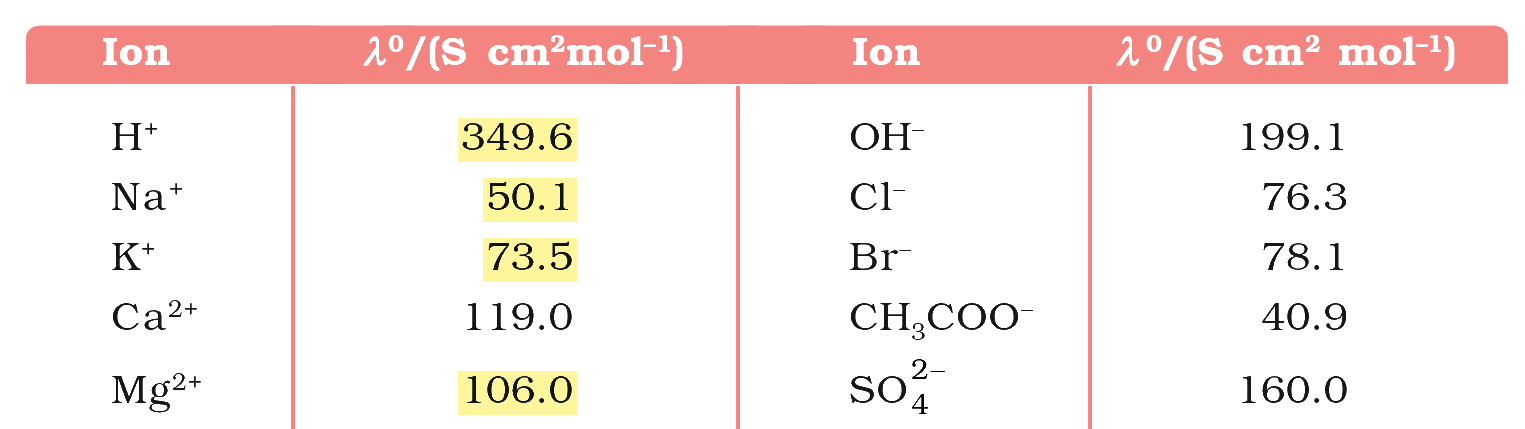
Arrange the following ions in order of their increasing limiting molar conductivities in water at 298 K?
A. K+
B. Na+
C. Mg2+
D. H+
Choose the correct answer from the options given below:
Answer & explanation
Correct answer: option 3
The correct answer is Option (3) → B, A, C, D
The limiting molar conductivity (λ°) of an ion measures how fast the ion moves through water under an electric field. It depends on:
Size of the hydrated ion: in water every ion carries a sheath of water molecules. A smaller bare ion has a higher charge density, attracts more water and becomes larger and slower. So among ions of the same charge: \( \ce{Na^{+}} \) (more hydrated) < \( \ce{K^{+}} \) (less hydrated).
Charge: a doubly charged ion carries twice the charge per mole, so \( \ce{Mg^{2+}} \) has a higher molar conductivity than the singly charged \( \ce{Na^{+}} \) and \( \ce{K^{+}} \), even though it is heavily hydrated.
Proton hopping: \( \ce{H^{+}} \) does not move as a whole ion; the proton is passed from one water molecule to the next along hydrogen bonds (Grotthuss mechanism). So \( \ce{H^{+}} \) has an exceptionally high conductivity.
Combined order, with the limiting molar conductivities at 298 K (S cm2 mol−1):
\( \displaystyle \ce{Na^+}\ (50.1) < \ce{K^+}\ (73.5) < \ce{Mg^2+}\ (106.0) < \ce{H^+}\ (349.6) \)
Matching the labels:
B. \( \ce{Na^{+}} \)
A. \( \ce{K^{+}} \)
C. \( \ce{Mg^{2+}} \)
D. \( \ce{H^{+}} \)
Shortcut: \( \ce{H^{+}} \) D is the fastest ion and \( \ce{Na^{+}} \) B is the slowest here. Only Option (3) starts with B and ends with D.
NCERT (2026-27 edition):
Variation of Conductivity and Molar Conductivity with Concentration – …