Which among the following statements about South Asia is not correct?
Answer & explanation
Correct answer: option 1
The correct answer is Option (1) → All countries in South Asia are democratic
Option (1) All countries in South Asia are democratic — False. The democratic record of the region is mixed. Pakistan has experienced both civilian and military rulers; it suffered a military coup in 1999 and has been run by a civilian government again only since 2008. Nepal was a constitutional monarchy till 2006, and Bhutan has a king: it became a constitutional monarchy only in 2008.
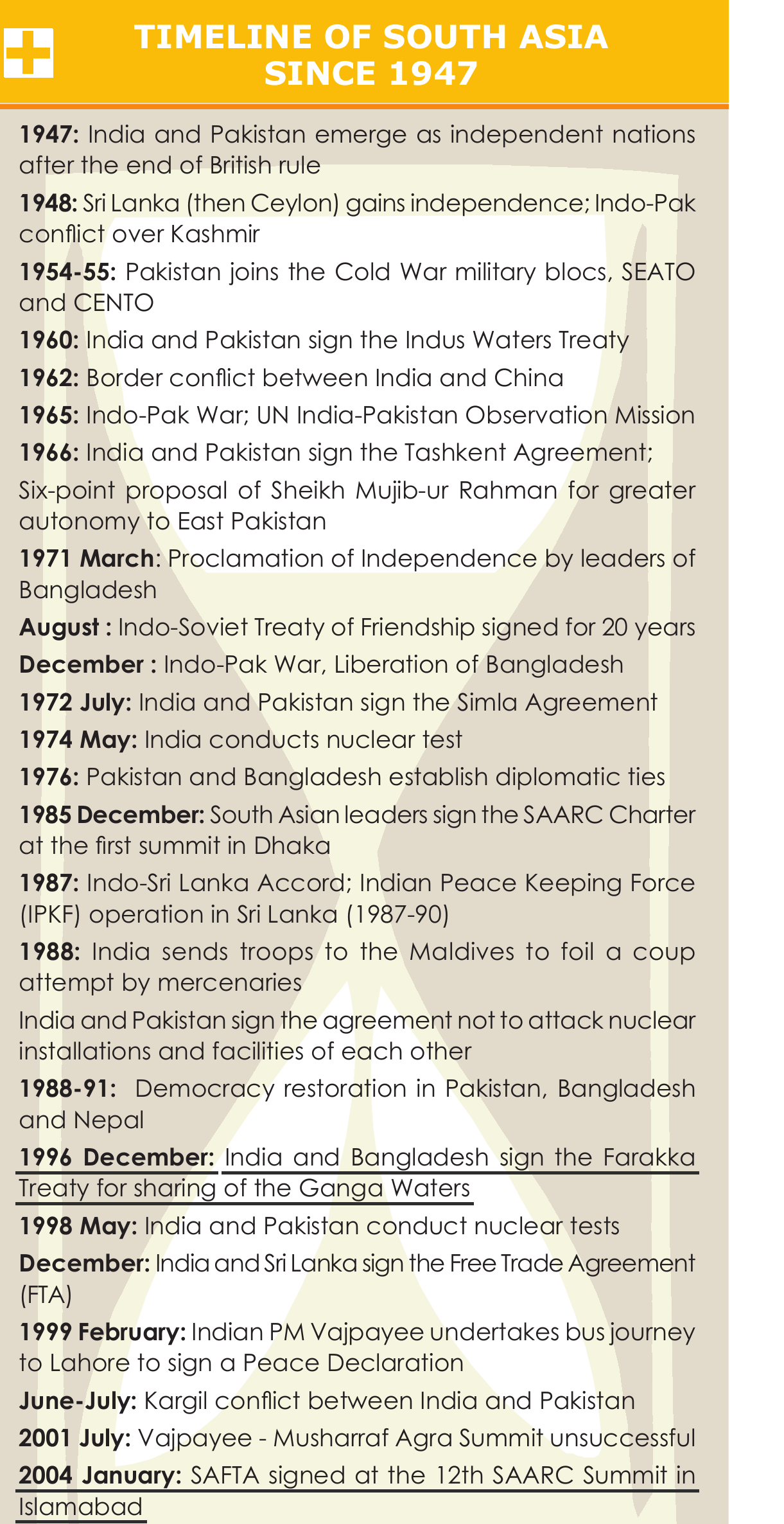
Option (2) Bangladesh and India have signed an agreement on river water sharing — True. In December 1996, India and Bangladesh signed the Farakka Treaty for sharing of the Ganga Waters.
Option (3) SAFTA was signed at the 12th SAARC summit in Islamabad — True. SAFTA was signed at the 12th SAARC Summit in Islamabad in January 2004; it came into effect on 1 January 2006.
Option (4) The US and China play an influential role in South-Asian politics — True. China and the United States remain key players in South Asian politics. China has a strategic partnership with Pakistan, and the US has had good relations with both India and Pakistan since the end of the Cold War and increasingly works as a moderator between them.
NCERT (2026-27): “What is South Asia? … Pakistan and Bangladesh have experienced both civilian and military rulers, with Bangladesh remaining a democracy in the post-Cold War period. Pakistan began the postCold War period with successive democratic governments under Benazir Bhutto and Nawaz Sharif respectively. But it suffered a military coup in 1999. It has been run by a civilian government again since 2008. Till 2006, Nepal was a constitutional monarchy with the danger of the king taking over executive powers. In 2008, the monarchy was abolished and Nepal emerged as a democratic republic. From the experience of Bangladesh and Nepal, we can say that democracy is becoming an accepted norm in the entire region of South Asia. What is South Asia? … Similar changes are taking place in the two smallest countries of the region. Bhutan became a constitutional monarchy in 2008. Under the leadership of the king, it emerged as a multi-party democracy.… Peace and Cooperation … No region exists in a vacuum. It is influenced by outside powers and events no matter how much it may try to insulate itself from non-regional powers. China and the United States remain key players in South Asian politics. Sino-Indian relations have improved significantly in the last ten years, but China’s strategic partnership with Pakistan remains a major irritant.… Peace and Cooperation … American involvement in South Asia has rapidly increased after the Cold War. The US has had good relations with both India and Pakistan since the end of the Cold War and increasingly works as a moderator in India-Pakistan relations. Economic reforms and liberal economic policies in both countries have greatly increased the depth of American participation in the region. The large South Asian diasporas in the US and the huge size of the population and markets of the region also give America an added stake in the future of regional security and peace.” NCERT (2026-27): Contemporary World Politics — Chapter 3: Contemporary South Asia, box ‘Timeline of South Asia’ (rows underlined)
|