The sodium soap prepared from glyceryl palmitate (C15H31COO)3C3H5, is:
Answer & explanation
Correct answer: option 2
The correct answer is Option (2) → C15H31COONa
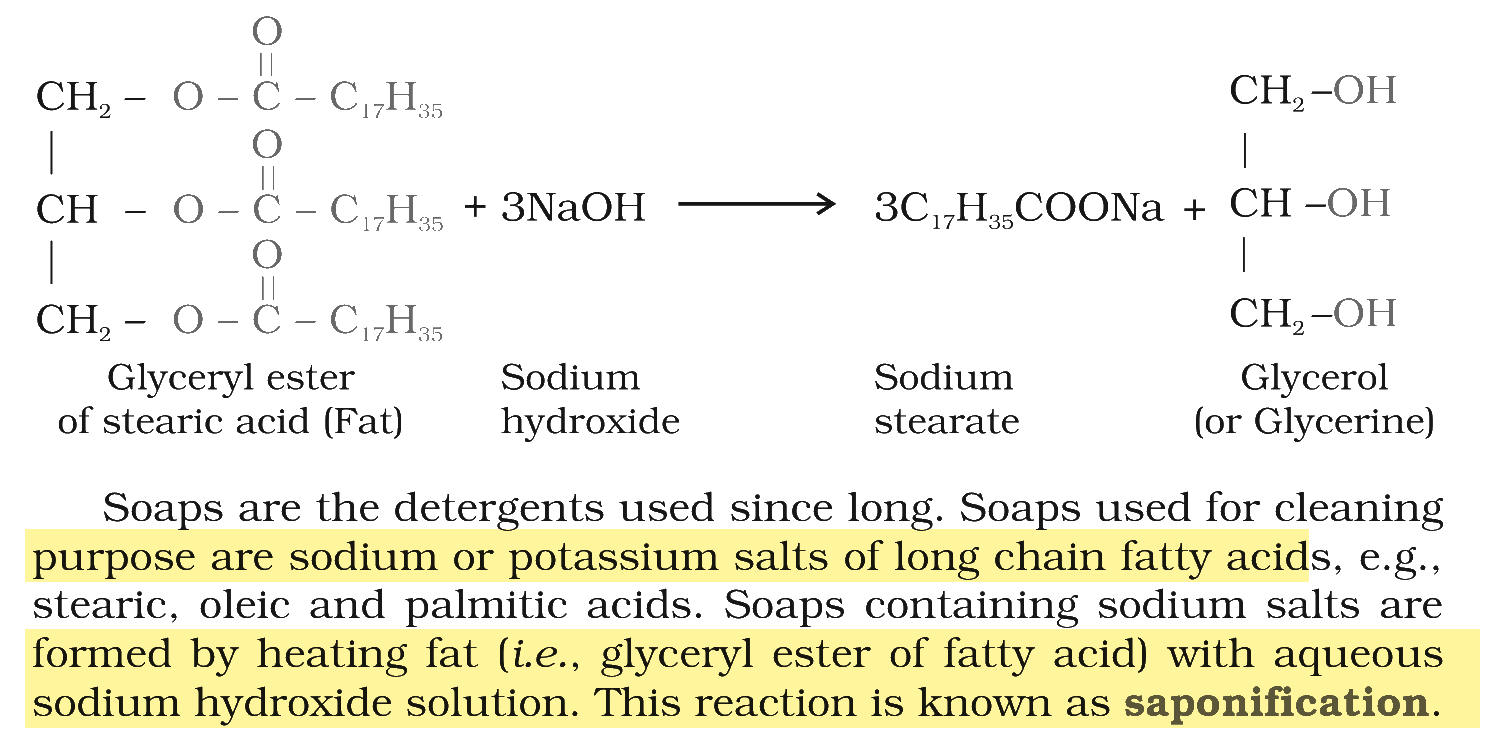
Soaps are sodium or potassium salts of long-chain fatty acids. They are made by heating a fat or oil (a glyceryl ester of fatty acids, a triglyceride) with aqueous sodium hydroxide. This hydrolysis is called saponification: each of the three ester groups gives one molecule of the sodium salt, and glycerol is set free.
\( \displaystyle \ce{(C15H31COO)3C3H5 + 3NaOH -> 3C15H31COONa + C3H5(OH)3} \)
\( \displaystyle \qquad\text{glyceryl palmitate}\qquad\qquad\quad\ \text{sodium palmitate}\quad\ \text{glycerol} \)
So the sodium soap is sodium palmitate, C15H31COONa.
Why the other options are incorrect
Option (1) (C3H5)3COONa — Incorrect. \( \ce{C3H5} \) is the glyceryl part, which ends up in glycerol, not in the soap.
Option (3) (C15H31COO)3Na — Incorrect. One \( \ce{Na^{+}} \) balances only one carboxylate ion; three palmitate ions would need three \( \ce{Na^{+}} \), giving three molecules of \( \ce{C15H31COONa} \).
Option (4) C3H5COONa — Incorrect. This would be a short-chain salt built from the glyceryl part; soaps contain the long fatty-acid chain.
NCERT (Pre-rationalised edition, 2022-23):
Soaps