
CUETMOCK
  • Pricing
  • Mentors
Log inStart freeStart free mocks→

First test, then trust

Try a free CUET mock test.

Join 5,00,000+ students who rehearsed exam day on the exact NTA screen before sitting CUET. On the web and on Android.

Start free mocks →Get the Android app
CUETMOCK

India's #1 CUET Mock Test Platform. Original NCERT-based questions on the exact NTA exam screen — trusted by 5,00,000+ students since CUET 2022.

Get it onGoogle PlayScan to download the CUETMOCK app

Mock tests

  • CUET mock test series
  • Commerce mocks
  • Humanities (Arts) mocks
  • Science mocks
  • Languages & GAT mocks
  • Free practice questions
  • Pricing

Resources

  • CUET exam guide
  • CUET syllabus
  • Universities accepting CUET
  • Expert blogs
  • News & notifications
  • Webinars & counselling
  • CUET score calculator
  • How we estimate your rank
  • FAQs

Company

  • About us
  • Our leadership & team
  • Our toppers
  • Mentors
  • For schools
  • Contact us
  • Terms
  • Privacy
  • Refund policy

Talk to us

+91 7696 6630 56info@cuetmock.comWhatsApp us

Our other platforms

  • JEE Mock — For IIT-JEE aspirants
  • NEET Mock — For NEET aspirants

Newsletter

Exam updates, study material and offers — no spam.

© 2026 NYC Ventures Pvt. Ltd.

701-702, Royal Business Park, Zirakpur, Punjab - 140603

  • Terms of use
  • Privacy policy
  • Refund policy
  • Contact us

iCUETMOCK is an independent preparation platform, not affiliated with the National Testing Agency (NTA). Always check exam details on the official NTA website.

  • Home
  • Mock tests
  • CUET guide
  • Pricing
  • Log in
Home/Practice questions/Chemistry
ChemistryPhysical: Electro Chemistry

A rod of metal A is dipped in a 1 M aqueous solution of B2+ ions at 2…

A rod of metal A is dipped in a 1 M aqueous solution of B2+ ions at 25 °C. The standard electrode potentials are E°(A2+/A) = −0.76 V and E°(B2+/B) = +0.34 V. What happens?

Answer & explanation+

Correct answer: option 2

The correct answer is Option (2) → B will gradually deposit on A

  • The lower the standard electrode potential, the stronger the metal is as a reducing agent. A metal with a lower E° reduces the ions of a metal with a higher E°.

  • Here E°(A2+/A) = −0.76 V is lower than E°(B2+/B) = +0.34 V, so metal A gives electrons to the B2+ ions:

        \( \displaystyle \ce{A(s) + B^2+(aq) -> A^2+(aq) + B(s)} \)

        \( \displaystyle E^{\circ}=E^{\circ}_{\ce{B^2+/B}}-E^{\circ}_{\ce{A^2+/A}}=0.34-(-0.76)=1.10\,\mathrm{V} \)

  • E° is positive, so the reaction takes place on its own. A dissolves as A2+, and the B2+ ions are reduced to metal B, which deposits on the rod of A. These are the values of zinc and copper, so this is the reaction of the Daniell cell.

Why the other options are incorrect

Option (1) A will gradually deposit on the rod — Incorrect. A is oxidised and goes into solution as A2+; the rod loses metal A, it does not gain it.

Option (3) No reaction will occur — Incorrect. No reaction would mean A has the higher E°. Here E° for the reaction is +1.10 V, so it is spontaneous.

Option (4) Water will be decomposed into H2 and O2 — Incorrect. Splitting water into H2 and O2 is a non-spontaneous change that needs electrical energy (electrolysis); a metal rod dipped in a salt solution does not do it.

NCERT (2026-27 edition):
2.2.1 Measurement of Electrode Potential – “… The overall reaction of the cell is the sum of above two reactions and we obtain the equation:”

    \( \displaystyle \ce{Zn(s) + Cu^2+(aq) -> Zn^2+(aq) + Cu(s)} \)

    \( \displaystyle \text{emf of the cell}=E^{\circ}_{\text{cell}}=E^{\circ}_{R}-E^{\circ}_{L}=0.34\,\mathrm{V}-(-0.76)\,\mathrm{V}=1.10\,\mathrm{V} \)

“… It may be seen that as we go from top to bottom in Table 2.1 the standard electrode potential decreases and with this, decreases the oxidising power of the species on the left and increases the reducing power of the species on the right hand side of the reaction.”

Table 2.1: Standard Electrode Potentials at 298 K
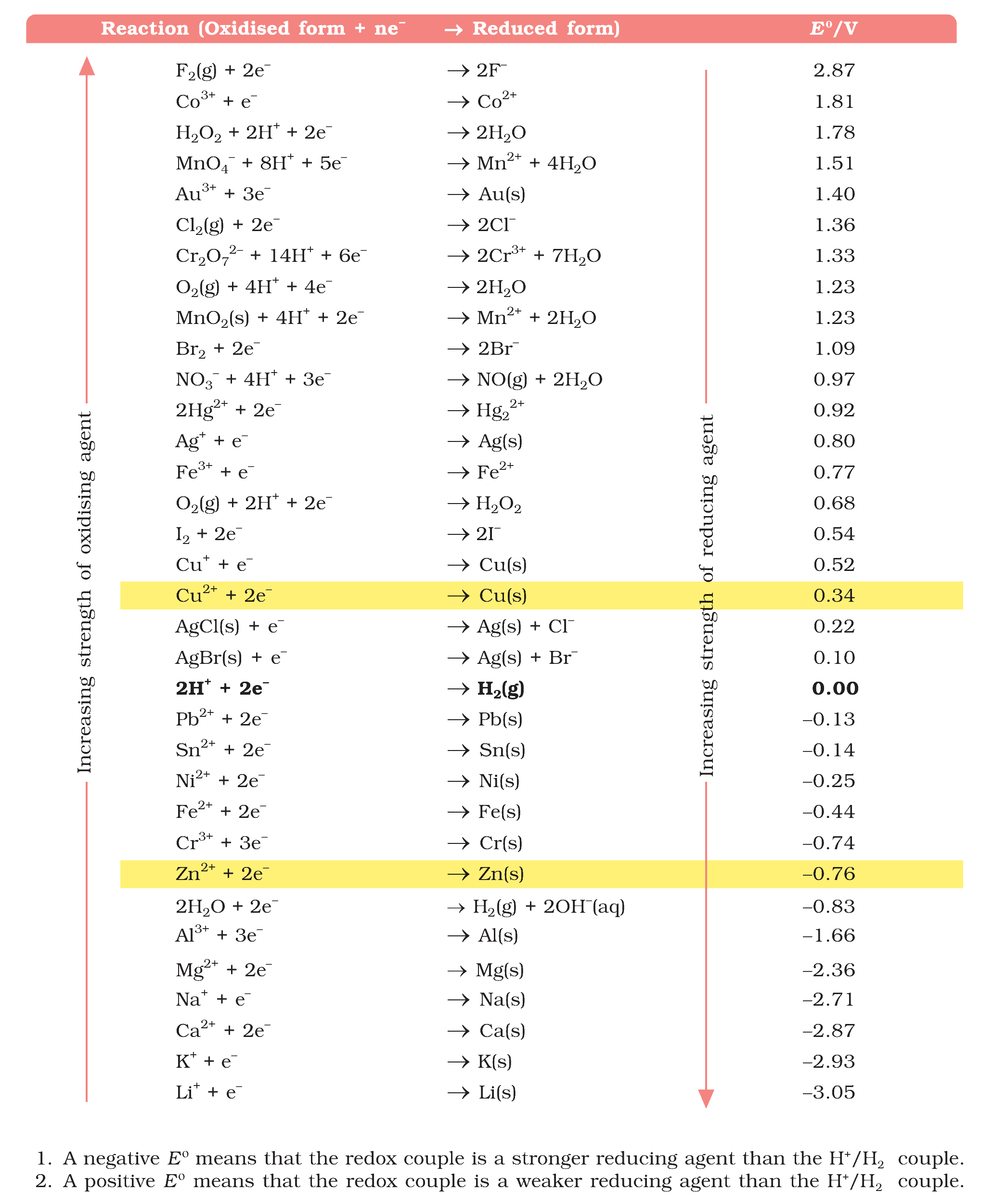
Textbook table

Advertisement

Practise more on Physical: Electro Chemistry

Chapter-wise mocks on the real NTA exam screen, with solutions and your rank. Your first mocks are free.

Start free mocks →

Advertisement

Next questions

  1. Sana's school lost a debate to School Q. She tells her friends, "They won only because the judges liked them; we are the better speakers."…Psychology · Social Influence and Group Processes
  2. Match List-I with List-IIList-IList-II(A)37.5% of 64(I)7(B)14% of 50(II)54(C)65% of 80(III)24(D)75% of 72(IV)52General Aptitude Test · Numerical Ability
  3. Sawai Jai Singh (1699–1743) founded the city of Jaipur. On which theme did he commission numerous paintings?Fine Arts · The Rajasthani Schools of Painting
  4. Which of the following is the meaning of ‘Pishtaq’ in the context of medieval Indo-Islamic architecture?General Aptitude Test · General Knowledge
  5. Pick the correct statement about the National Planning Committee. (A) It was set up by Indian National Congress (B) The committee was set u…Sociology · Social Change and Development in India: Structural Change
  6. The degree of the differential equation ≤ft(1+dy/dx)^4 = ≤ft((d^2y)/(dx^2) )^2 is :Maths. Section A · Determinants
  7. Calculate the birth rate if there were 60 sparrows in a garden last year and through reproduction 24 new sparrows are added this year ?Biology · Organisms and Populations
  8. Assertion: Economic sustainability in the regions of the Indira Gandhi Canal cannot be attained only through the development of agriculture…Geography · India-People and Economy: Planning and Sustainable development in Indian Context
  9. Which letter-cluster will replace the question mark (?) to complete the given series? KRPD, ?, QNRL, TLSP, WJTTGeneral Aptitude Test · General Ability
  10. Who discovered neutron?General Aptitude Test · General Knowledge