


CUET Preparation Today
A diet is to contain atleast 80 units of vitamin A and 100 units of minerals. Two foods $F_1$ and $F_2$ are available. Food $F_1$ costs ₹4 per unit and $F_2$ cost ₹6 per unit. One unit of food $F_1$ contains 3 units of vitamin A and 4 units of minerals. One unit of $F_2$ contains 6 units of vitamin A and 3 units of minerals. Formulate this a linear programming problem and find graphically the minimum cost for diet that consists of mixture of these two foods and also meets the minimal nutritional requirements. |
₹104 ₹106 ₹112 ₹120 |
₹104 |
The correct answer is Option (1) → ₹104 Let x units of food $F_1$ and y units of food $F_2$ be mixed and Z (in ₹) be the total cost of the food, then the problem can be formulated as an L.P.P. as follows: Minimize $Z = 4x + 6y$ subject to constraints $3x + 6y ≥ 80$ (vitamin A constraint) $4x + 3y ≥ 100$ (minerals constraint) $x ≥ 0, y ≥ 0$ (non-negativity constraints)
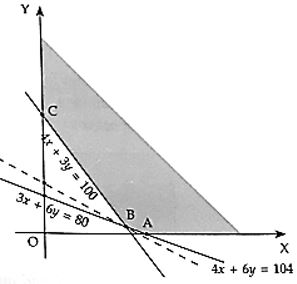
Draw the lines $3x+6y= 80$ and $4x + 3y=100$ and shade the region satisfied by the above inequalities. The feasible region (unbounded, convex) is shown shaded. The corner points are $A(\frac{80}{3},0), B(24, \frac{4}{3})$ and $C(0,\frac{100}{3})$. At $A(\frac{80}{3},0), Z=\frac{320}{3}=106\frac{2}{3}$; at $B(24,\frac{4}{3}), Z = 96 + 6 ×\frac{4}{3}=96+8=104$; at $C(0, \frac{100}{3}), Z = 200$. Among the values of Z, the least value is 104. We draw the line $4x + 6y= 104$ (shown dotted in the given figure) and note that the half plane $4x + 6y < 104$ has no common point with the feasible region, therefore, Z has minimum value. Minimum value of Z is 104 and it occurs at the point $B(24,\frac{4}{3})$. Hence, the minimum cost of the diet is ₹104 when we mix 24 units of food $F_1$ and $\frac{4}{3}$ units of food $F_2$. |