
A metal with a negative standard reduction potential, when dipped in a solution of its ions, has a tendency to
Answer & explanation
Correct answer: option 1
The correct answer is Option (1) → pass into the solution
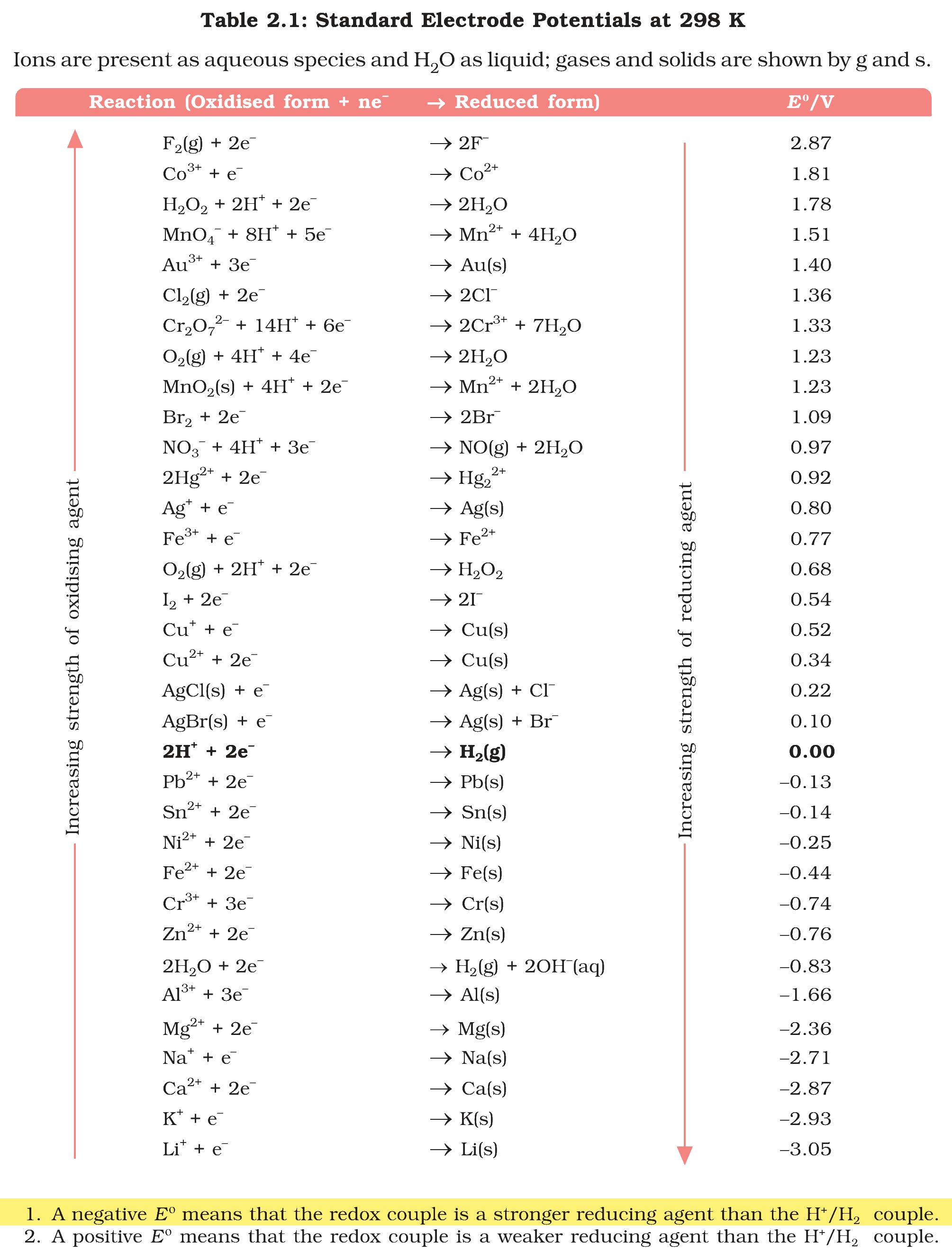
A negative standard reduction potential means the metal is a stronger reducing agent than hydrogen: it gives up electrons more readily than hydrogen does. Dipped in a solution of its ions, its atoms tend to be oxidised, \( \ce{M -> M^{n+} + ne^-} \), and pass into the solution as ions.
Why the other options are incorrect
Option (2) be deposited from the solution — Incorrect. Deposition is reduction of the ions, the stronger tendency of metals with a positive E°, such as copper.
Option (3) become positively charged — Incorrect. The atoms leave as ions and leave their electrons behind, so the metal becomes negatively charged with respect to the solution.
Option (4) remain neutral — Incorrect. At the metal–solution interface there is a separation of charges, which is the origin of the electrode potential; the metal does not stay neutral.
NCERT (2026-27 edition):
Table 2.1: Standard Electrode Potentials at 298 K – “1. A negative E° means that the redox couple is a stronger reducing agent than the H+/H2 couple.”
2.2 Galvanic Cells – “… At the same time, metal atoms of the electrode have a tendency to go into the solution as ions and leave behind the electrons at the electrode trying to make it negatively charged.”