Match List-I (IUPAC name) with List-II (common name).
| List-I | List-II |
|---|---|
| (A) 2-Methylphenol | (I) Ethylene glycol |
| (B) Propane-1,2,3-triol | (II) p-Cresol |
| (C) 4-Methylphenol | (III) Glycerol |
| (D) Ethane-1,2-diol | (IV) o-Cresol |
Choose the correct answer from the options given below:
Answer & explanation
Correct answer: option 3
The correct answer is Option (3) → A-IV, B-III, C-II, D-I
In the IUPAC name of a polyhydric alcohol, the ‘e’ of the alkane is kept and di, tri, etc. before ‘ol’ give the number of –OH groups. The cresols are methylphenols; in their common names ortho stands for 1,2- and para for 1,4-substitution, counting the carbon that carries –OH as C-1.
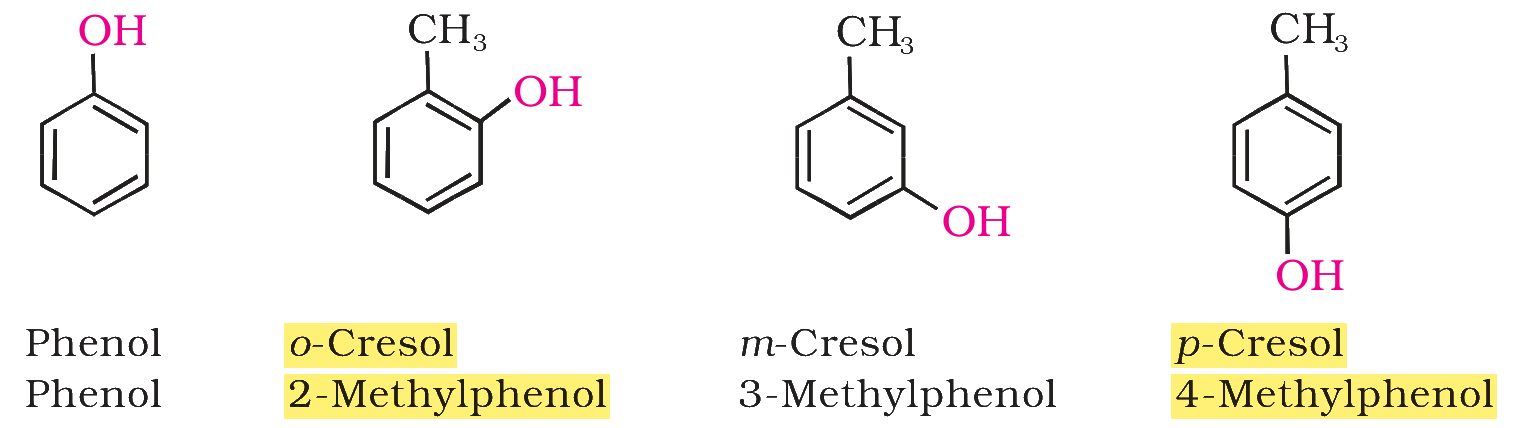
(A) 2-Methylphenol — This matches (IV) o-Cresol. The –CH3 group is on C-2, next to the –OH group, so the ring is 1,2-disubstituted (ortho).
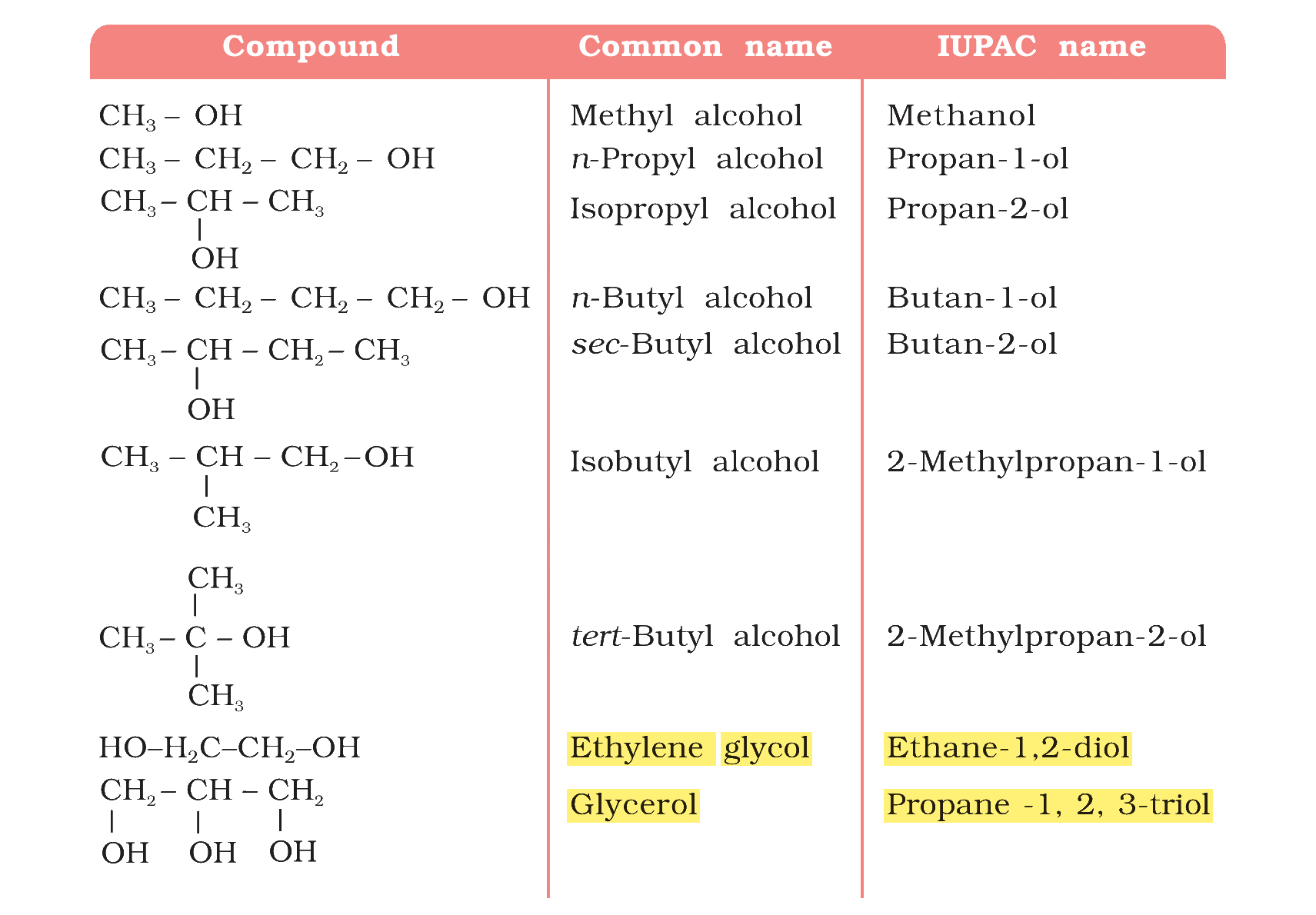
(B) Propane-1,2,3-triol — This matches (III) Glycerol. It has three –OH groups, one on each carbon of a propane chain, so it is a trihydric alcohol.
(C) 4-Methylphenol — This matches (II) p-Cresol. The –CH3 group is on C-4, opposite the –OH group, so the ring is 1,4-disubstituted (para).
(D) Ethane-1,2-diol — This matches (I) Ethylene glycol. It has two –OH groups on a two-carbon chain, HO–CH2–CH2–OH, so it is a dihydric alcohol.
NCERT (2026-27 edition):
7.2 Nomenclature – “…For naming polyhydric alcohols, the ‘e’ of alkane is retained and the ending ‘ol’ is added. The number of –OH groups is indicated by adding the multiplicative prefix, di, tri, etc., before ‘ol’. The positions of –OH groups are indicated by appropriate locants, e.g., HO–CH2–CH2–OH is named as ethane–1, 2-diol. Table 7.1 gives common and IUPAC names of a few alcohols as examples.”
Table 7.1: Common and IUPAC Names of Some Alcohols
“(b) Phenols: …As structure of phenol involves a benzene ring, in its substituted compounds the terms ortho (1,2- disubstituted), meta (1,3-disubstituted) and para (1,4-disubstituted) are often used in the common names.”