Read the passage carefully and answer the questions based on the passage:
Alcohols are versatile compounds as they can act as both nucleophile and electrophiles. They undergo reactions based on cleavage of O-H and C-O bonds. The cleavage of O-H bond reflects the acidic character of alcohols. However they are weaker acids than water, phenol and carboxylic acids. Alkoxide ion formed by loss of proton from the OH group of alcohols react with water to form the corresponding conjugate acid-base pair. They act as Bronsted base due to presence of unshared electron pairs on oxygen.Both alcohols and phenol react with carboxylic acids, acid chlorides and anhydrides to form esters. The introduction of acetyl group in alcohols or phenol is known as acetylation. Alcohols react with hydrogen halides to form alkyl halides which form the basis of Lucas test. They also undergo acid catalyzed dehydration to form alkenes. Alcohols can be easily oxidized with variety of oxidizing agents. The nature of the product depends on the type of oxidizing agent and the nature of alcohol.
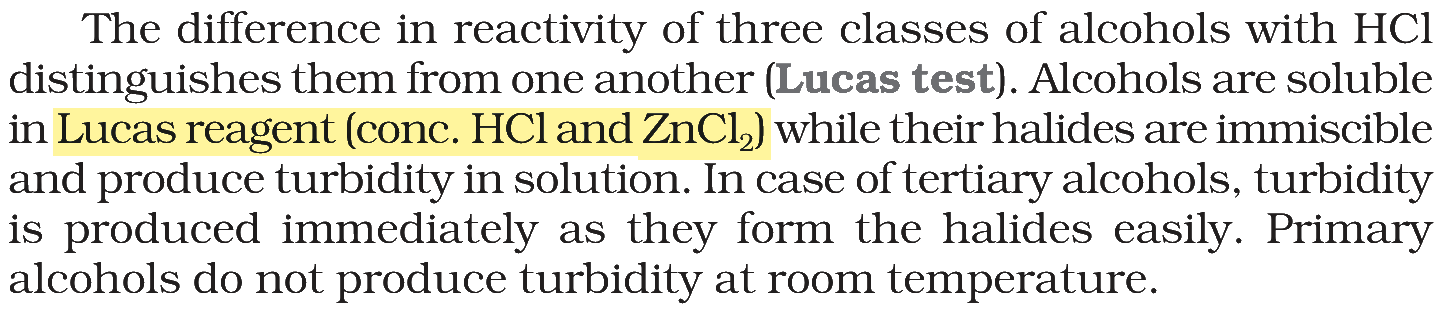
Lucas reagent is
Answer & explanation
Correct answer: option 1
The correct answer is Option (1) → Conc. HCl and \(ZnCl_2\)
The Lucas test tells primary, secondary and tertiary alcohols apart by how fast they react with HCl to form an alkyl chloride. Lucas reagent is concentrated HCl with anhydrous zinc chloride. \( \ce{ZnCl2} \) is a Lewis acid; it bonds to the oxygen of the alcohol and helps the C–O bond to break:
\( \displaystyle \ce{ROH + HCl} \xrightarrow{\text{anhyd. }\ce{ZnCl2}} \ce{RCl + H2O} \)
NCERT (2026-27 edition):
Reaction with Hydrogen Halides – …