CUET Preparation Today
Match List I with List II
Choose the correct answer from the options given below |
A-I, B-II, C-III, D-IV A-II, B-III, C-IV, D-I A-III, B-II, C-I, D-IV A-III, B-I, C-II, D-IV |
A-III, B-I, C-II, D-IV |
The correct answer is option 4. A-III, B-I, C-II, D-IV.
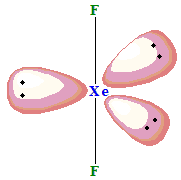
Let us go through each xenon compound from List I and use VSEPR (Valence Shell Electron Pair Repulsion) theory to explain the geometry and the shape in detail. A. \( \text{XeF}_2 \) (Xenon Difluoride): Electronic Configuration of Xenon: \( [Kr]4d^{10}5s^25p^6 \) Xenon is in group 18 and has 8 valence electrons. In \( \text{XeF}_2 \), xenon forms two bonds with fluorine atoms, using 2 of its valence electrons. This leaves 6 electrons or 3 lone pairs on xenon. The molecule has 5 electron pairs (2 bonding pairs + 3 lone pairs) around xenon. According to VSEPR theory, these 5 pairs adopt a trigonal bipyramidal arrangement to minimize repulsion. The 3 lone pairs occupy the equatorial positions, leaving the 2 fluorine atoms in the axial positions. This arrangement leads to a linear geometry for the molecule. Shape: Linear (III)
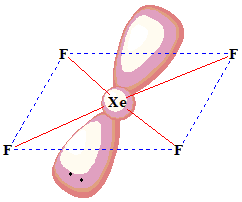
B. \( \text{XeF}_4 \) (Xenon Tetrafluoride): Xenon forms 4 bonds with fluorine atoms, using 4 of its 8 valence electrons. This leaves 4 electrons or 2 lone pairs on xenon. The molecule has 6 electron pairs (4 bonding pairs + 2 lone pairs). According to VSEPR theory, these 6 pairs adopt an octahedral arrangement. The 2 lone pairs take positions opposite to each other (180° apart) to minimize repulsion, while the 4 fluorine atoms occupy the positions in a plane (equatorial positions). This results in a square planar geometry. Shape: Square planar (I)
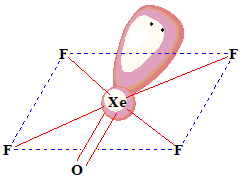
C. \( \text{XeOF}_4 \) (Xenon Oxytetrafluoride): Xenon is bonded to 1 oxygen atom and 4 fluorine atoms. Oxygen forms a double bond, while fluorine forms single bonds. Xenon uses 5 of its 8 valence electrons to form bonds, leaving 3 electrons (or 1 lone pair) on xenon. The molecule has 6 electron pairs (5 bonding pairs + 1 lone pair). These 6 pairs adopt an octahedral arrangement, but the lone pair distorts the symmetry. The lone pair occupies one position, and the 5 bonds (1 with oxygen and 4 with fluorine) form a square pyramidal geometry. Shape: Square pyramidal (II)
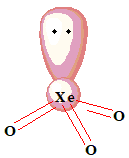
D. \( \text{XeO}_3 \) (Xenon Trioxide): Xenon forms 3 bonds with oxygen atoms, leaving 2 electrons (or 1 lone pair) on xenon. The molecule has 4 electron pairs (3 bonding pairs + 1 lone pair). These 4 pairs adopt a tetrahedral arrangement according to VSEPR theory. The lone pair distorts the geometry, resulting in a pyramidal shape. Shape: Pyramidal (IV)
Thus, the correct option is 4: A-III, B-I, C-II, D-IV |