Which one of the following is a tertiary alcohol?
Answer & explanation
Correct answer: option 3
The correct answer is Option (3) → C6H5–C(CH3)2–OH (2-phenylpropan-2-ol)
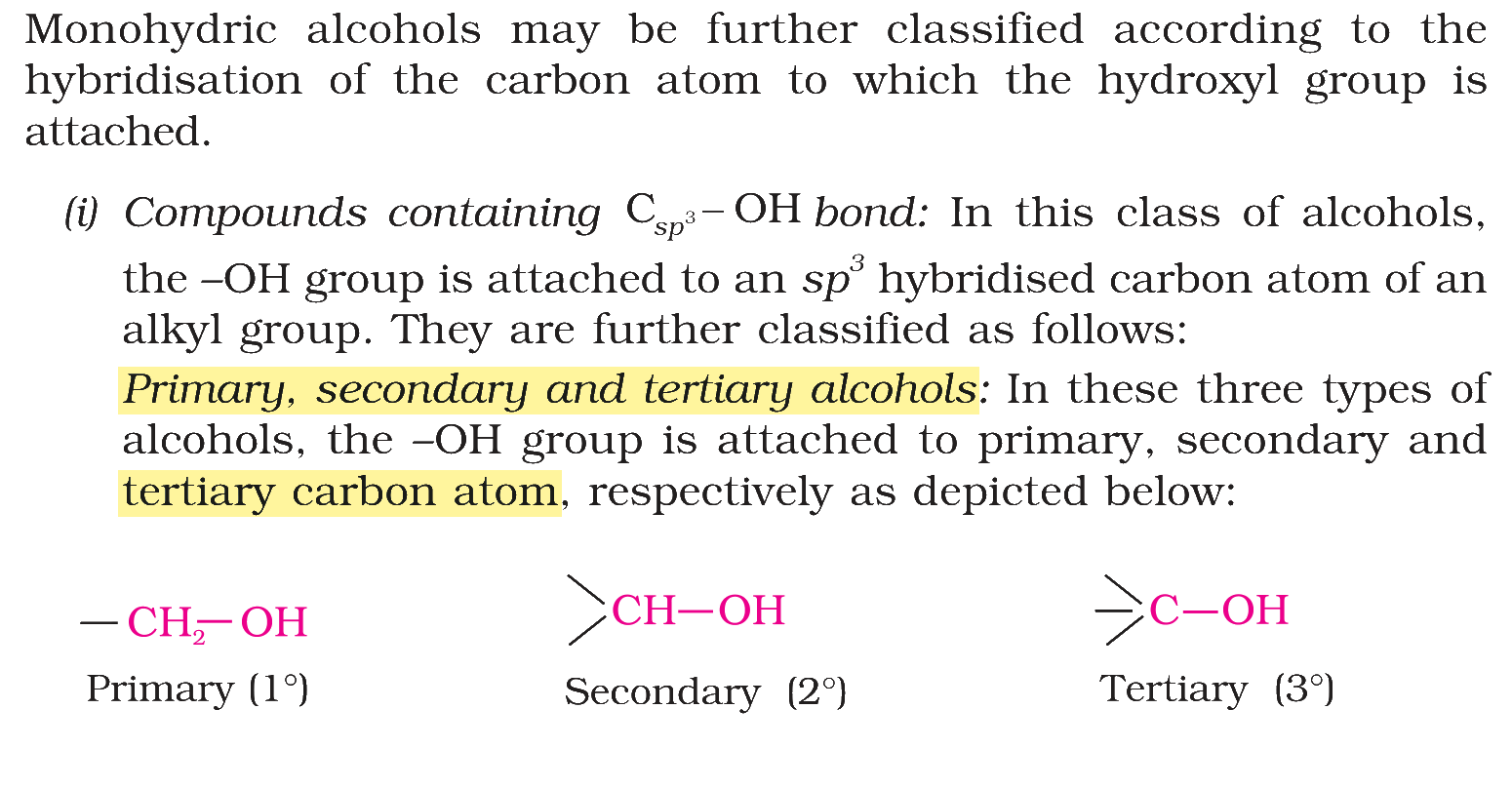
Alcohols are classed by the carbon that carries the –OH group: in primary, secondary and tertiary alcohols the –OH is attached to a carbon bonded to one, two and three other carbon atoms, respectively.
In Option (3) the carbon bearing –OH is bonded to two \( \ce{CH3} \) groups and to the benzene ring, i.e. to three carbons, so it is a tertiary alcohol.
Why the other options are incorrect
Option (1) C6H5–CH(OH)–CH3 (1-phenylethanol) — Incorrect. The –OH carbon is bonded to the ring and to one \( \ce{CH3} \) (two carbons) and carries an H; it is a secondary (benzylic) alcohol.
Option (2) CH2=CH–CH2–CH2–OH (but-3-en-1-ol) — Incorrect. The –OH is on a \( \ce{CH2} \) bonded to one carbon; a primary alcohol.
Option (4) CH3–CH2–CH2–OH (propan-1-ol) — Incorrect. The –OH is on a terminal \( \ce{CH2} \); a primary alcohol.
NCERT (2026-27 edition):
Alcohols— Mono, Di, Tri or Polyhydric Alcohols – …