
CUETMOCK
  • Pricing
  • Mentors
Log inStart freeStart free mocks→

First test, then trust

Try a free CUET mock test.

Join 5,00,000+ students who rehearsed exam day on the exact NTA screen before sitting CUET. On the web and on Android.

Start free mocks →Get the Android app
CUETMOCK

India's #1 CUET Mock Test Platform. Original NCERT-based questions on the exact NTA exam screen — trusted by 5,00,000+ students since CUET 2022.

Get it onGoogle PlayScan to download the CUETMOCK app

Mock tests

  • CUET mock test series
  • Commerce mocks
  • Humanities (Arts) mocks
  • Science mocks
  • Languages & GAT mocks
  • Free practice questions
  • Pricing

Resources

  • CUET exam guide
  • CUET syllabus
  • Universities accepting CUET
  • Expert blogs
  • News & notifications
  • Webinars & counselling
  • CUET score calculator
  • How we estimate your rank
  • FAQs

Company

  • About us
  • Our leadership & team
  • Our toppers
  • Mentors
  • For schools
  • Contact us
  • Terms
  • Privacy
  • Refund policy

Talk to us

+91 7696 6630 56info@cuetmock.comWhatsApp us

Our other platforms

  • JEE Mock — For IIT-JEE aspirants
  • NEET Mock — For NEET aspirants

Newsletter

Exam updates, study material and offers — no spam.

© 2026 NYC Ventures Pvt. Ltd.

701-702, Royal Business Park, Zirakpur, Punjab - 140603

  • Terms of use
  • Privacy policy
  • Refund policy
  • Contact us

iCUETMOCK is an independent preparation platform, not affiliated with the National Testing Agency (NTA). Always check exam details on the official NTA website.

  • Home
  • Mock tests
  • CUET guide
  • Pricing
  • Log in
Home/Practice questions/Physics
PhysicsElectric Charges and Fields

The figure shows the electric field lines in the vicinity of two poin…

The figure shows the electric field lines in the vicinity of two point charges \( q_1 \) and \( q_2 \). Which of the following statements concerning this situation is true?
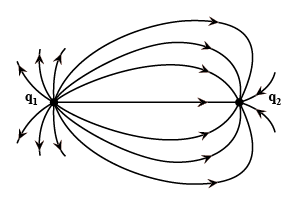
Figure for the question

Answer & explanation+

Correct answer: option 2

The correct answer is Option (2) → The magnitude of the ratio \( q_1/q_2 \) is more than 1

Electric field lines start from positive charges and end at negative charges. By Gauss’s law, the flux through a closed surface around a charge is \( q/\varepsilon_0 \). The flux is proportional to the number of field lines. So a larger charge has more lines leaving or entering it.

Option (1) \( q_1 \) is negative and \( q_2 \) is positive — Incorrect. From the figure, the arrows point away from \( q_1 \) and into \( q_2 \), so \( q_1 \) is positive and \( q_2 \) is negative.

Option (2) The magnitude of the ratio \( q_1/q_2 \) is more than 1 — Correct. From the figure, many more lines leave \( q_1 \) than end on \( q_2 \). Several lines from \( q_1 \) go off without reaching \( q_2 \). Hence \( |q_1|\gt|q_2| \), that is, \( |q_1/q_2|\gt1 \).

Option (3) \( q_1 \) and \( q_2 \) have the same polarity — Incorrect. The lines run from \( q_1 \) to \( q_2 \). This happens only between charges of opposite sign. The lines of two like charges bend away from each other.

Option (4) The electric field is strongest midway between the charges — Incorrect. Midway, the lines are spread far apart, so the field there is weak. The lines crowd together close to each charge, and the field is strongest there.

NCERT (2026-27):
Electric Flux – “We now come to the definition of electric flux. Electric flux Δφ through an area element ΔS is defined by

    \( \Delta\phi=\mathbf{E}\cdot\Delta\mathbf{S}=E\,\Delta S\cos\theta \qquad (1.11) \)

which, as seen before, is proportional to the number of field lines cutting the area element.”


Gauss’s Law – “We state Gauss’s law without proof:

    \( \text{Electric flux through a closed surface }S=q/\varepsilon_0 \qquad (1.31) \)

q = total charge enclosed by S.”

Advertisement

Practise more on Electric Charges and Fields

Chapter-wise mocks on the real NTA exam screen, with solutions and your rank. Your first mocks are free.

Start free mocks →

Advertisement

Next questions

  1. Which of the following statements about the product method of calculating national income are true?(A) The product method is also called th…Economics · Macro Economics: National Income Accounting
  2. The Greatest Integer Function f : R → R given by f(x) = [x], x ∈ R and [x] denotes the greatest integer less than or equal to x is:Maths. Section B1 · Relations and Functions
  3. Find the number of quadrilaterals in the given figures?General Aptitude Test · Verbal Reasoning
  4. Which among the following is not the method of valuation of goodwill?Accountancy Part A · Admission of a Partner
  5. Which one of the following is NOT a limitation of controlling?Business Studies · Controlling
  6. What is the criticism that Tiplut Nongbri made about tribal institutions?Sociology · Social Change and Development in India: The Constitution and Social Change
  7. A takes 10 minutes more than B in covering a certain distance. If their speeds are in the ratio of 3 : 4, then what is the time taken by B…General Aptitude Test · Numerical Ability
  8. These torts do not care about the intention or carelessness of the defendant when the defendant caused the injury. The claimant does not ha…Legal Studies · Topics of Law
  9. Match List-I with List-II.List-IList-II(A) Prostate gland(I) Progesterone(B) Corpus luteum(II) Male external genitalia(C) Colostrum(III) Ma…Biology · Human Reproduction
  10. Which among the following can prepare their own food ?General Aptitude Test · General Knowledge