Who among the following are associated with Revolt of 1857?
A. Shah Mal
B. Nana Sahib
C. V. D. Savarkar
D. Kesari Singh Barahat
E. Danka Shah
Choose the correct answer from the options given below:
Answer & explanation
Correct answer: option 2
The correct answer is Option (2) → A, B, E only
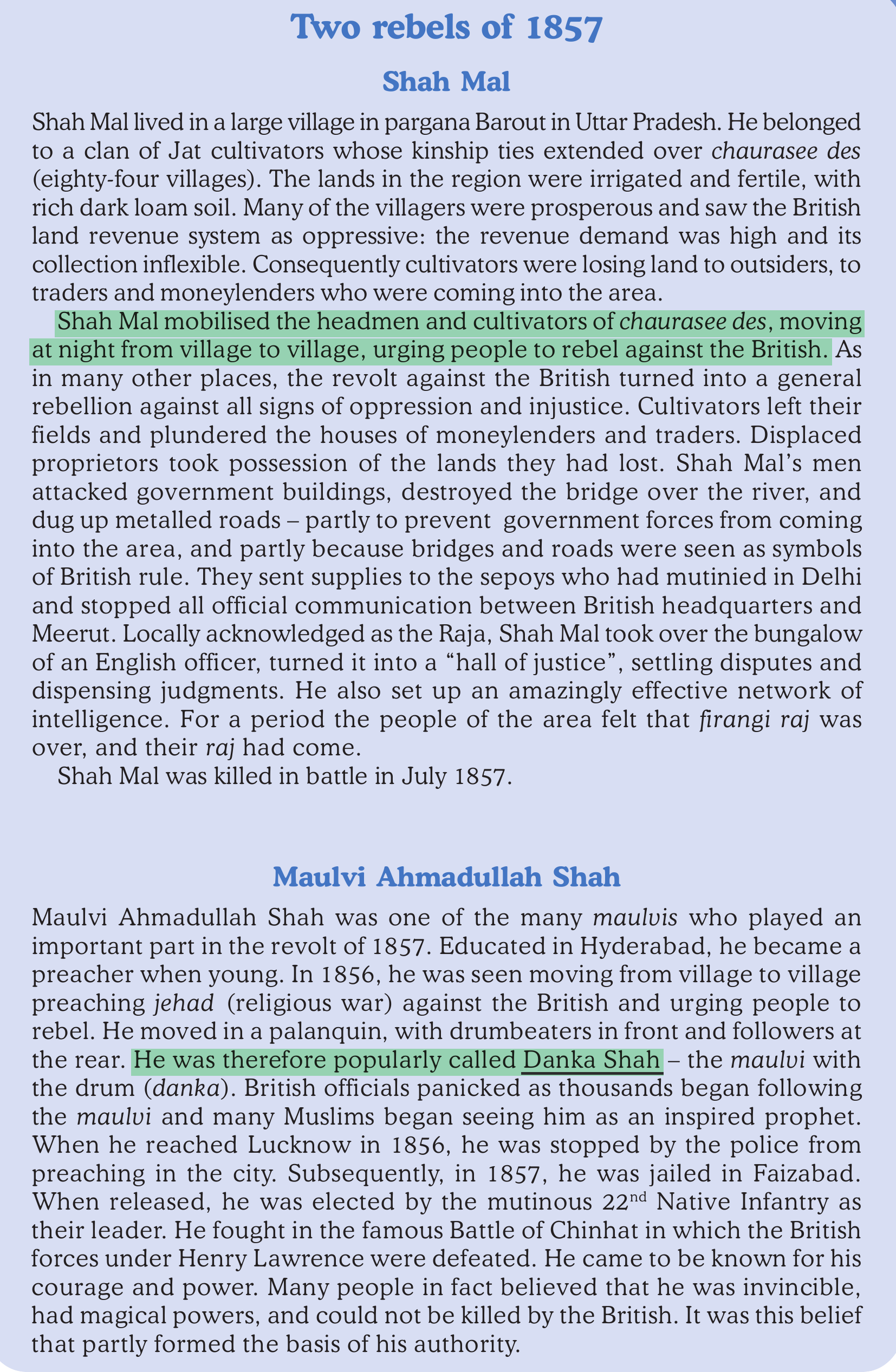
(A) Shah Mal — Correct. Shah Mal mobilised the villagers of pargana Barout in Uttar Pradesh during the revolt.
(B) Nana Sahib — Correct. In Kanpur, the sepoys and the people of the town gave Nana Sahib, the successor to Peshwa Baji Rao II, no choice but to join the revolt as their leader.
(C) V. D. Savarkar — Incorrect. V.D. Savarkar was a nationalist of the early twentieth century, born long after 1857. He wrote a book on the revolt in 1909, calling it a war of independence, but he took no part in it.
(D) Kesari Singh Barahat — Incorrect. Kesari Singh Barahat was a poet and freedom fighter of Rajasthan in the early twentieth century; he had no part in the revolt of 1857.
(E) Danka Shah — Correct. Maulvi Ahmadullah Shah, who preached against the British and fought in the Battle of Chinhat, was popularly called Danka Shah, the maulvi with the drum (danka).
Note: V.D. Savarkar and Kesari Singh Barahat are not in NCERT (2026-27); they are explained here for the benefit of the students.
NCERT (2026-27): “1.3 Leaders and followers … Elsewhere, similar scenes were enacted though on a minor scale. In Kanpur, the sepoys and the people of the town gave Nana Sahib, the successor to Peshwa Baji Rao II, no choice save to join the revolt as their leader. In Jhansi, the rani was forced by the popular pressure around her to assume the leadership of the uprising. So was Kunwar Singh, a local zamindar in Arrah in Bihar.… 1.3 Leaders and followers … Elsewhere, local leaders emerged, urging peasants, zamindars and tribals to revolt. Shah Mal mobilised the villagers of pargana Barout in Uttar Pradesh; Gonoo, a tribal cultivator of Singhbhum in Chotanagpur, became a rebel leader of the Kol tribals of the region.”
|