Read the passage and answer the questions:
Cash or Kind?
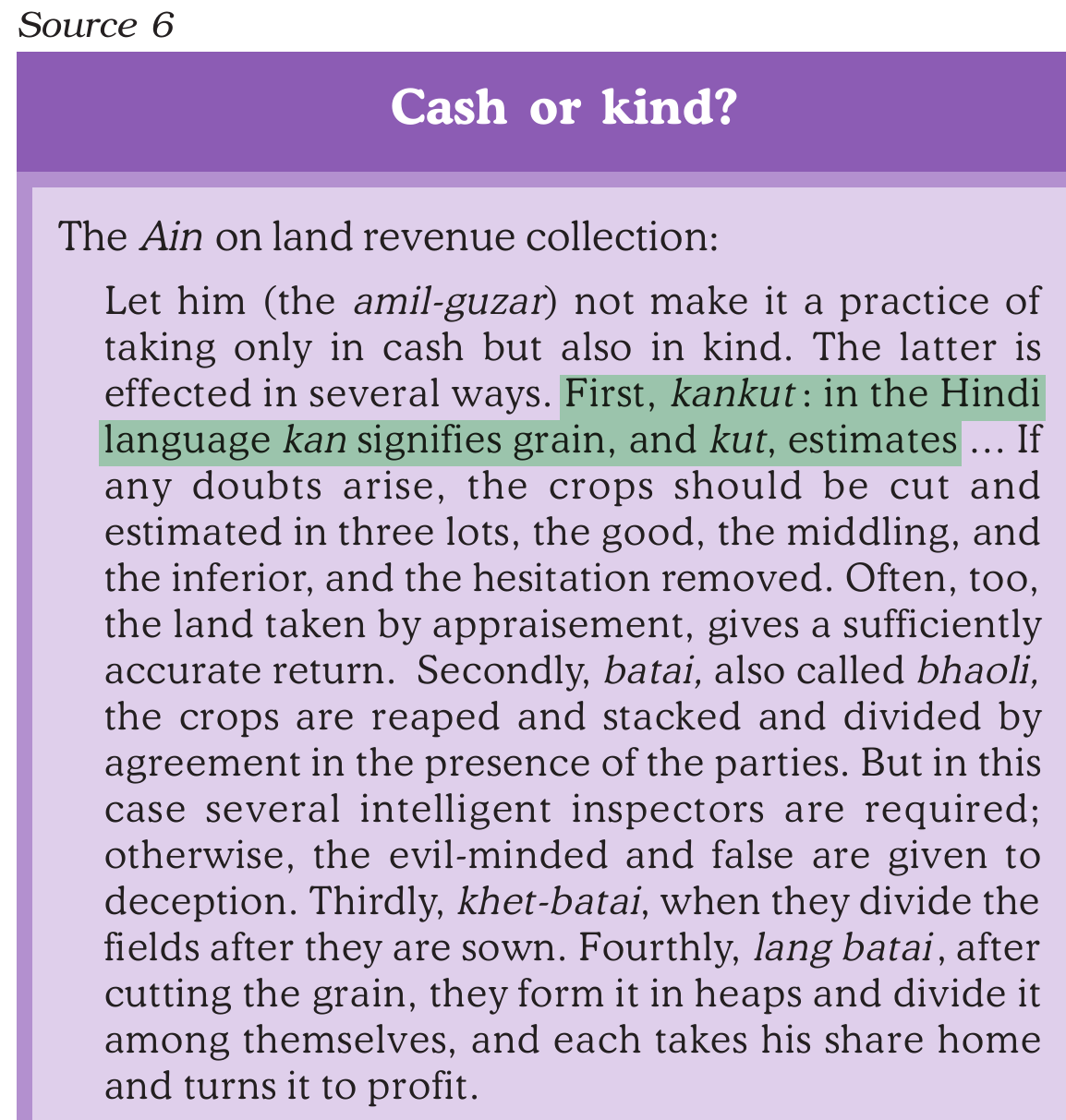
The Ain on land revenue collection: Let him (the amil-guzar) not make it a practice of taking only in cash but also in kind. The latter is effected in several ways. First, kankut : in the Hindi language kan signifies grain, and kut, estimates ... If any doubts arise, the crops should be cut and estimated in three lots, the good, the middling, and the inferior, and the hesitation removed. Often, too, the land taken by appraisement, gives a sufficiently accurate return. Secondly, batai, also called bhaoli, the crops are reaped and stacked and divided by agreement in the presence of the parties. But in this case several intelligent inspectors are required; otherwise, the evil-minded and false are given to deception. Thirdly, khet-batai, when they divide the fields after they are sown. Fourthly, lang batai, after cutting the grain, they form it in heaps and divide it among themselves, and each takes his share home and turns it to profit.
What is the meaning of the word 'Kan' in Kankut?
Answer & explanation
Correct answer: option 2
The correct answer is Option (2) → Grain
In kankut, the first way of taking revenue in kind, kan signifies grain in the Hindi language and kut means estimates, so the grain on the field was estimated and the share fixed on that estimate.
Note: This passage is taken from the NCERT chapter ‘Peasants, Zamindars and the State’, word for word, from the source box ‘Cash or kind?’, an excerpt from the Ain. A single source box of a few lines has given five questions here, so read the source boxes as carefully as the main text.
NCERT: Themes in Indian History Part II — Chapter 8: Peasants, Zamindars and the State (2026-27)
|