Read the passage and answer the questions:
Charkha
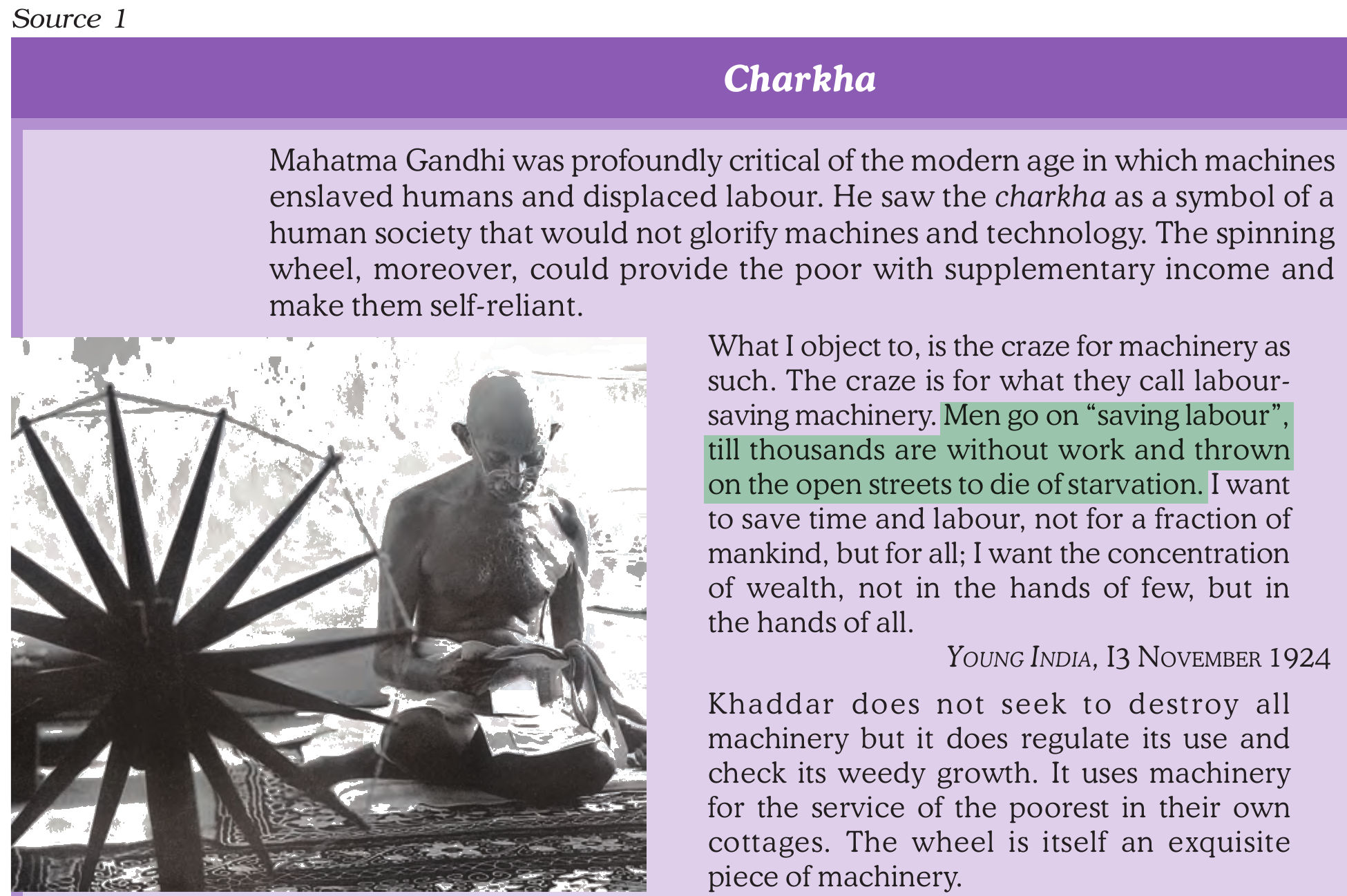
What I object to, is the craze for machinery as such. The craze is for what they call labour-saving machinery. Men go on “saving labour”, till thousands are without work and thrown on the open streets to die of starvation. I want to save time and labour, not for a fraction of mankind, but for all; I want the concentration of wealth, not in the hands of few, but in the hands of all.
YOUNG INDIA, 13 NOVEMBER 1924
Khaddar does not seek to destroy all machinery but it does regulate its use and check its weedy growth. It uses machinery for the service of the poorest in their own cottages. The wheel is itself an exquisite piece of machinery.
YOUNG INDIA, 17 MARCH 1927
What does the writer mean by ‘saving labour’?
Answer & explanation
Correct answer: option 3
The correct answer is Option (3) → Employing machines instead of human beings
The writer objects to the craze for ‘labour-saving machinery’. In his words, men go on ‘saving labour’ till thousands are without work and thrown on the streets to starve. So ‘saving labour’ here means using machines to do the work that people did, so that the people lose their jobs.
Option (1) Saving the lives of humans — Incorrect. The passage says the opposite: this ‘saving’ leaves people to die of starvation.
Option (2) Saving humans from hard labour — Incorrect. This is the plain dictionary sense, but the writer puts the words in quotation marks to mock it: the labour is ‘saved’ only by throwing the workers out of work.
Option (3) Employing machines instead of human beings — Correct. Labour-saving machinery replaces human workers, which is why thousands are left without work.
Option (4) Giving honor to human labour — Incorrect. The phrase is about replacing human labour, not honouring it.
Note: This passage is taken from the NCERT chapter ‘Mahatma Gandhi and the Nationalist Movement’, where it is printed as a source box, ‘Charkha’. NTA left out only the box’s opening lines, and those lines name the writer. Read the source boxes as carefully as the main text; this one box has given five questions.
NCERT: Themes in Indian History Part III — Chapter 11: Mahatma Gandhi and the Nationalist Movement (2026-27)
|