CUETMOCK
  • Pricing
  • Mentors
Log inStart freeStart free mocks→

First test, then trust

Try a free CUET mock test.

Join 5,00,000+ students who rehearsed exam day on the exact NTA screen before sitting CUET. On the web and on Android.

Start free mocks →Get the Android app
CUETMOCK

India's #1 CUET Mock Test Platform. Original NCERT-based questions on the exact NTA exam screen — trusted by 5,00,000+ students since CUET 2022.

Get it onGoogle PlayScan to download the CUETMOCK app

Mock tests

  • CUET mock test series
  • Browse all papers
  • Commerce mocks
  • Humanities (Arts) mocks
  • Science mocks
  • Languages & GAT mocks
  • Free practice questions
  • Pricing

Resources

  • CUET exam guide
  • CUET syllabus
  • Universities accepting CUET
  • Expert blogs
  • News & notifications
  • Webinars & counselling
  • CUET score calculator
  • How we estimate your rank
  • FAQs

Company

  • About us
  • Our leadership & team
  • Our toppers
  • Mentors
  • For schools
  • Contact us
  • Terms
  • Privacy
  • Refund policy

Talk to us

+91 7696 6630 56info@cuetmock.comWhatsApp us

Our other platforms

  • JEE Mock — For IIT-JEE aspirants
  • NEET Mock — For NEET aspirants

Newsletter

Exam updates, study material and offers — no spam.

© 2026 NYC Ventures Pvt. Ltd.

701-702, Royal Business Park, Zirakpur, Punjab - 140603

  • Terms of use
  • Privacy policy
  • Refund policy
  • Contact us

iCUETMOCK is an independent preparation platform, not affiliated with the National Testing Agency (NTA). Always check exam details on the official NTA website.

  • Home
  • Mock tests
  • CUET guide
  • Pricing
  • Log in
Home/Practice questions/General Aptitude Test
General Aptitude TestVerbal ReasoningSyllogism

In the following question below are given some statements followed by…

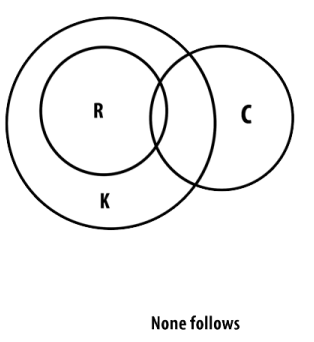
In the following question below are given some statements followed by some conclusions based on those statements. Taking the given statements to be true even if they seem to be at variance from commonly known facts. Read all the conclusions and then decide which of the given conclusion logically follows the given statements.

Statements:

I. Some R are C.

II. All R are K.

Conclusion:

I. All K are R.

II. All C are R.

III. All C are K.

Answer & explanation+

Correct answer: option 3

Advertisement

Practise more on Verbal Reasoning

Chapter-wise mocks on the real NTA exam screen, with solutions and your rank. Your first mocks are free.

Start free mocks →

Advertisement

Next questions

  1. Rearrange the following parts to form a meaningful sentence:- (A) but you can have a holiday on(B) sea travel is normally on a ferry,(C) th…English · Arrange in Meaningful Sequence
  2. Kelucharan Mohapatra was an exponent of which of the following categories of dance?General Aptitude Test · General Knowledge
  3. Manganese shows all the oxidation states from +2 to +7, but scandium and titanium, at the beginning of the first transition series, show fe…Chemistry · Inorganic: D and F Block Elements
  4. A photograph in the chapter on framing the Constitution shows Edwin Montague, the author of the reforms of 1919 that bear his name. What di…History · Modern India: Framing the Constitution
  5. The painting 'A view of a hill village in Rajmahal' was made by William Hodges in 1782, during a visit to the Jangal Mahals. On whose invit…History · Modern India: Colonialism and the Countryside
  6. 'When the Principal of DPS was on the verge of retirement, the management of the school contacted a specialized business firm in order to f…Business Studies · Staffing
  7. About ____________ the first cellular forms of life appeared on earth.Biology · Evolution
  8. Given below are the steps involved in the process of zone refining for removing impurities which are more soluble in the melt than solid st…Chemistry · Inorganic: General Principles and Processes of Isolation of Elements
  9. Which of the following is correct in respect of "Pinaka" System?General Aptitude Test · General Knowledge
  10. Which of the following is NOT an agent of pollination in flowering plants?Biology · Sexual Reproduction in Flowering Plants