Increase in the income of buyers (in case of inferior goods) will cause
Answer & explanation
Correct answer: option 1
The correct answer is Option (1) → Fall in equilibrium price and quantity.
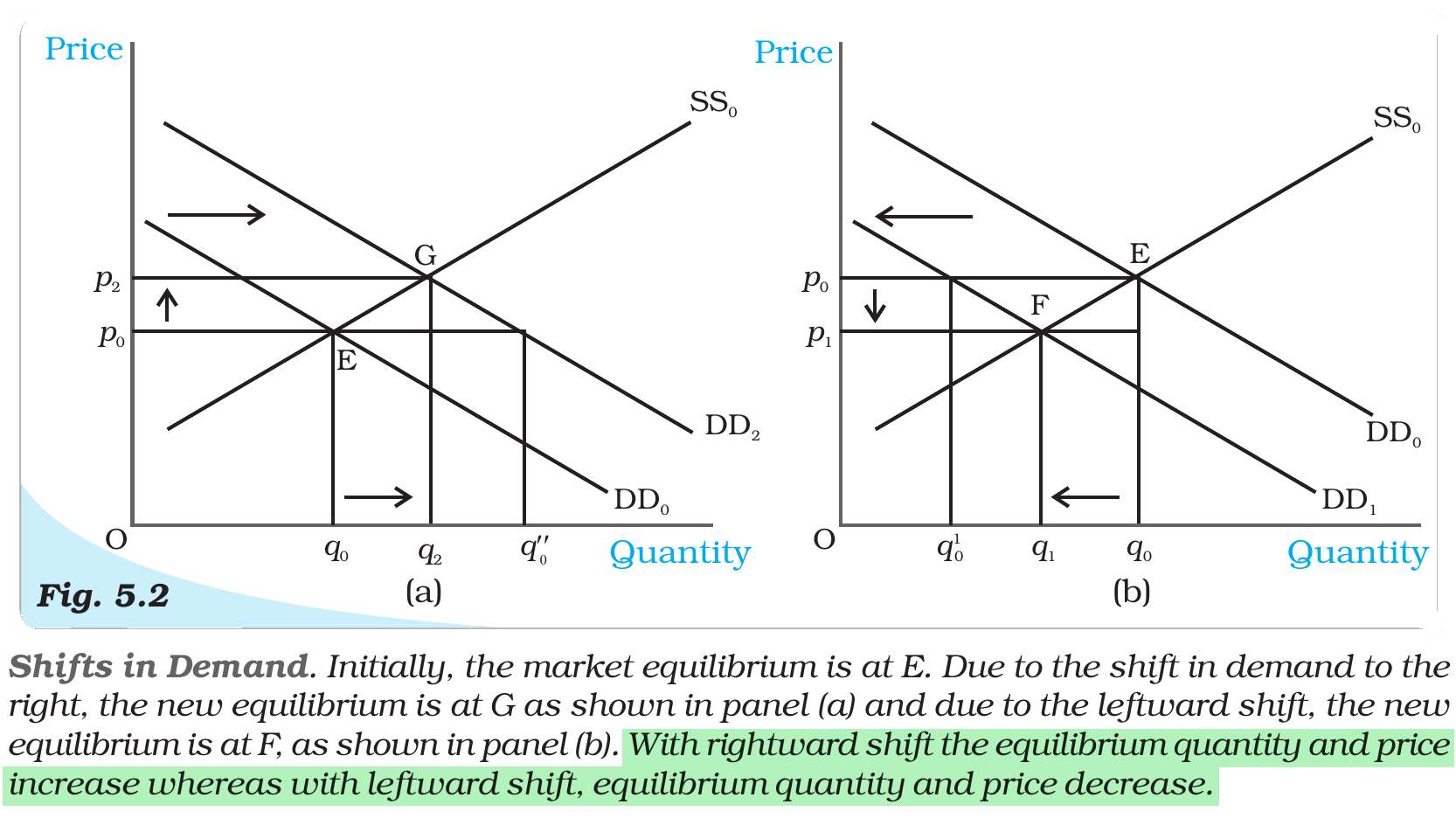
When income rises, buyers demand less of an inferior good. Its demand curve shifts leftward, so both the equilibrium price and the equilibrium quantity fall.
At the old price there is now excess supply, because sellers offer more than buyers want. Sellers lower the price until the market clears at a smaller quantity. A normal good moves the other way: its demand curve shifts rightward, and price and quantity both rise.
NCERT (2026-27): “Demand Shift …Now suppose the market demand curve shifts rightward to DD2 with supply curve remaining unchanged at SS0, as shown in panel (a). This shift indicates that at any price the quantity demanded is more than before. Therefore, at price p0 now there is excess demand in the market equal to q0q’’0. In response to this excess demand some individuals will be willing to pay higher price and the price would tend to rise. The new equilibrium is attained at G where the equilibrium quantity q2 is greater than q0 and the equilibrium price p2 is greater than p0. Similarly if the demand curve shifts leftward to DD1, as shown in panel (b), at any price the quantity demanded will be less than what it was before the shift. Therefore, at the initial equilibrium price p0 now there will be excess supply in the market equal to q’0 q0 in response to which some firms will reduce the price of their commodity so that they can sell their desired quantity. The new equilibrium is attained at the point F at which the demand curve DD1 and the supply curve SS0 intersect and the resulting equilibrium price p1 is less than p0 and quantity q1 is less than q0.… …With an increase in income, consumers are able to spend more money on some goods. But recall from Chapter 2 that the consumers will spend less on an inferior good with increase in income whereas for a normal good, with prices of all commodities and tastes and preferences of the consumers held constant, we would expect the demand for the good to increase at each price as a result of which the market demand curve will shift rightward.…”
|