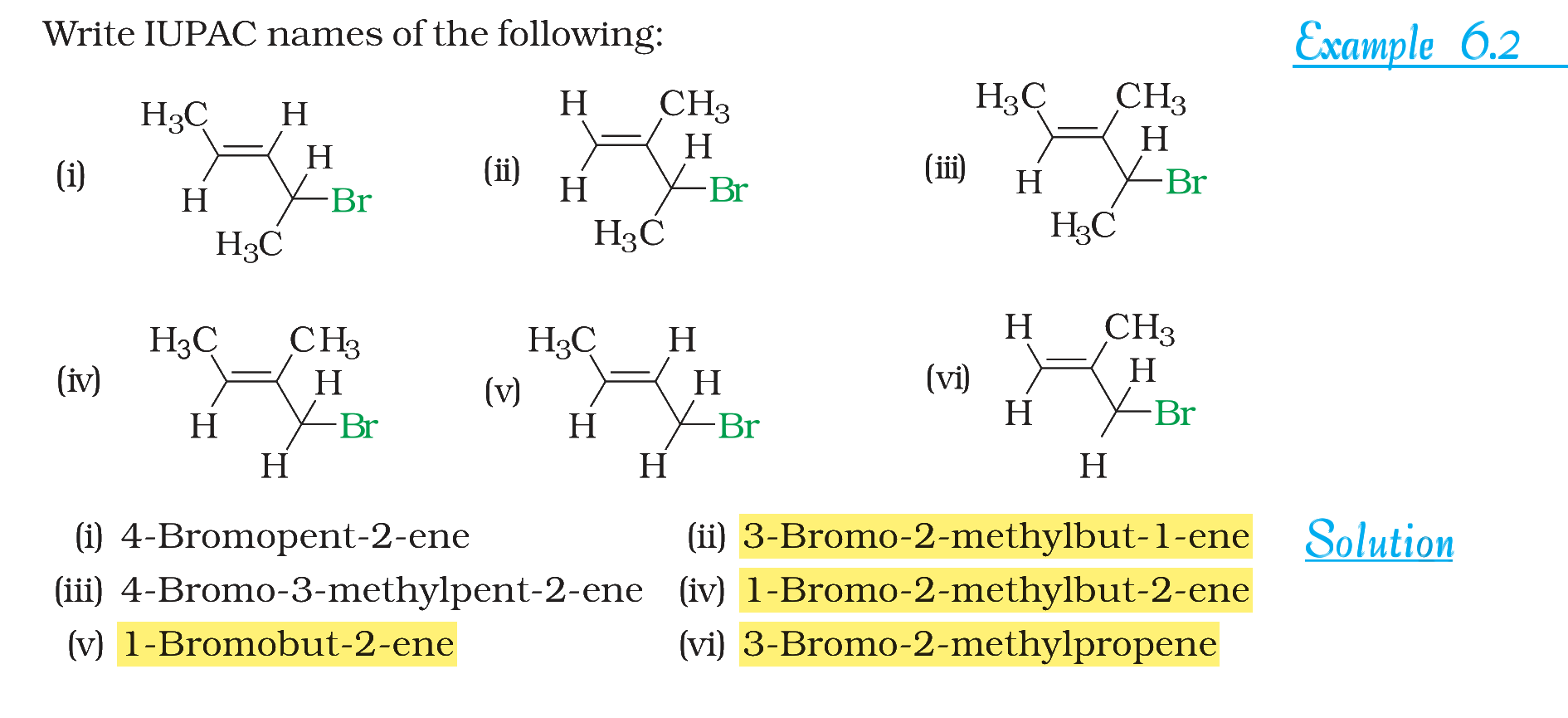
Match the compounds in List-I with their IUPAC names in List-II.
| List-I (Compound) | List-II (IUPAC name) |
|---|---|
| (A) \( \ce{CH3-CH=CH-CH2Br} \) | (I) 3-Bromo-2-methylbut-1-ene |
| (B) \( \ce{CH2=C(CH3)-CH2Br} \) | (II) 1-Bromobut-2-ene |
| (C) \( \ce{CH2=C(CH3)-CH(Br)-CH3} \) | (III) 1-Bromo-2-methylbut-2-ene |
| (D) \( \ce{CH3-CH=C(CH3)-CH2Br} \) | (IV) 3-Bromo-2-methylpropene |
Choose the correct answer from the options given below:
Answer & explanation
Correct answer: option 1
The correct answer is Option (1) → A-II, B-IV, C-I, D-III
In the IUPAC system these compounds are named as bromo-substituted alkenes. The parent chain is the longest chain that contains the C=C double bond. It is numbered so that the double bond gets the lowest number; if that is the same from both ends, the substituents (bromo, methyl) get the lowest numbers.
(A) \( \ce{CH3-CH=CH-CH2Br} \) — This matches (II) 1-Bromobut-2-ene. The chain has four carbons and the double bond is at C-2 from either end. Numbering from the CH2Br end puts bromine on C-1.
(B) \( \ce{CH2=C(CH3)-CH2Br} \) — This matches (IV) 3-Bromo-2-methylpropene. The longest chain with the double bond has only three carbons (C-1 = C-2); the methyl group is on C-2 and bromine on C-3.
(C) \( \ce{CH2=C(CH3)-CH(Br)-CH3} \) — This matches (I) 3-Bromo-2-methylbut-1-ene. The four-carbon chain is numbered from the CH2= end so that the double bond is at C-1; methyl is on C-2 and bromine on C-3.
(D) \( \ce{CH3-CH=C(CH3)-CH2Br} \) — This matches (III) 1-Bromo-2-methylbut-2-ene. The double bond is at C-2 from either end, so the substituents decide: numbering from the CH2Br end gives the locants 1 and 2 (not 3 and 4).
NCERT (2026-27 edition):
6.2 Nomenclature – “…In the IUPAC system of nomenclature, alkyl halides are named as halosubstituted hydrocarbons.”
Example 6.2