
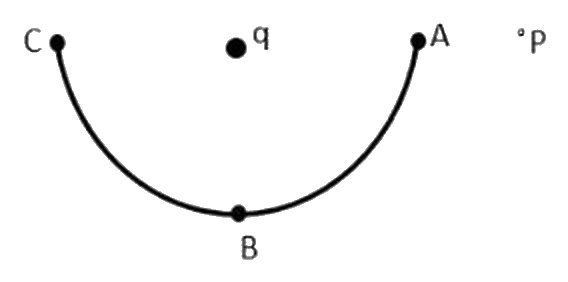
Consider the figure as shown below. If work done in bringing a point charge from infinity to points A, B and C are \( W_A \), \( W_B \) and \( W_C \), respectively, then, which of the following relation is correct?
Answer & explanation
Correct answer: option 3
The correct answer is Option (3) → \( W_A = W_B = W_C \)
The work done in bringing a test charge \( q_0 \) from infinity to a point is \( W = q_0 V \), where \( V \) is the electric potential of the charge q at that point. The potential of a point charge is \( V = kq/r \), which depends only on the distance \( r \) from q.
The points A, B and C lie on a semicircle whose centre is the charge q (as drawn), so they are all at the same distance from q. Hence
\( \displaystyle V_A = V_B = V_C \;\Rightarrow\; W_A = W_B = W_C \)
The work done is the same for all three points, because the path taken does not matter and the potentials are equal.
Note: The figure shows a point P that the question does not mention, and the question does not say that q is at the centre of the arc; it is drawn there. The question has been answered with q at the centre, as drawn, so that A, B and C are equidistant from q.
Note: A similar question was also asked in CUET (UG) 2026 on 14-05-2026 (Slot 2).
NCERT (2026-27):
Equipotential Surfaces – “An equipotential surface is a surface with a constant value of potential at all points on the surface. For a single charge q, the potential is given by Eq. (2.8):
\( \displaystyle V = \frac{1}{4\pi\varepsilon_0}\,\frac{q}{r} \)
This shows that V is a constant if r is constant. Thus, equipotential surfaces of a single point charge are concentric spherical surfaces centred at the charge.”